<?xml version="1.0" encoding="utf-8"?><feed xmlns="http://www.w3.org/2005/Atom" ><generator uri="https://jekyllrb.com/" version="3.10.0">Jekyll</generator><link href="https://mattsclancy.github.io/feed.xml" rel="self" type="application/atom+xml" /><link href="https://mattsclancy.github.io/" rel="alternate" type="text/html" /><updated>2026-04-27T15:32:17+00:00</updated><id>https://mattsclancy.github.io/feed.xml</id><title type="html">mattsclancy</title><subtitle>Data and statistics work of public interest.</subtitle><author><name>Matt Clancy</name></author><entry><title type="html">A Lifetime Wellbeing Index: Happiness Weighted by Life Expectancy</title><link href="https://mattsclancy.github.io/2026/04/27/total-lifetime-wellbeing.html" rel="alternate" type="text/html" title="A Lifetime Wellbeing Index: Happiness Weighted by Life Expectancy" /><published>2026-04-27T00:00:00+00:00</published><updated>2026-04-27T00:00:00+00:00</updated><id>https://mattsclancy.github.io/2026/04/27/total-lifetime-wellbeing</id><content type="html" xml:base="https://mattsclancy.github.io/2026/04/27/total-lifetime-wellbeing.html"><![CDATA[<p>The Cantril ladder captures how satisfied people report feeling with their lives right now, but it says nothing about how long they live. A simple composite index — Cantril score multiplied by life expectancy at birth — adds that second dimension. This post constructs that index, plots it against GDP per capita, and examines within-country trends across the same five-period panel used in <a href="https://mattsclancy.github.io/2026/04/22/easterlin-paradox.html">Income and Happiness Across 156 Countries</a>. A second version of the index replaces total life expectancy with healthy life expectancy (HALE), which excludes years lived with severe illness or disability.</p>

<h2 id="the-index-and-what-it-measures">The index and what it measures</h2>

<p>The lifetime wellbeing index for a country is its Cantril ladder score (0–10) multiplied by its life expectancy at birth in years. The unit can be read as happiness-weighted life-years: a country where the average person rates their life 6 out of 10 and lives to 75 has an index of 450, while a country where people rate their life equally at 6 but live to 60 has an index of 360.</p>

<p>The two components capture different things. The Cantril score reflects how people evaluate their current lives. Life expectancy reflects how long those lives last, incorporating the effects of nutrition, healthcare, infrastructure, violence, and disease. A country can score identically on the Cantril ladder as another and still have a substantially different lifetime wellbeing index if their life expectancies differ.</p>

<p>Note that life satisfaction and life expectancy are not necessarily uncorrelated; health is itself a predictor of life satisfaction.</p>

<h2 id="data">Data</h2>

<p>Life satisfaction scores are from the World Happiness Report (Gallup World Poll Cantril ladder, 0–10). Total life expectancy at birth and healthy life expectancy (HALE) at birth are from Our World in Data. GDP per capita is from the World Bank via Our World in Data, in 2021 international dollars at PPP.</p>

<p>The main analysis uses the same five non-overlapping periods as the <a href="https://mattsclancy.github.io/2026/04/22/easterlin-paradox.html">Easterlin paradox post</a>: Cantril scores at years 2012, 2015, 2018, 2021, and 2024, each representing the survey average of the preceding three calendar years. For each period, GDP per capita and life expectancy are both averaged over the same three-year window (GDP as a geometric mean, life expectancy as an arithmetic mean). The final panel contains 733 country-period observations across 156 countries. The HALE data ends at 2021, so the HALE version uses four periods (2012–2021) and 586 observations across 155 countries.</p>

<h2 id="cross-country-relationship">Cross-country relationship</h2>

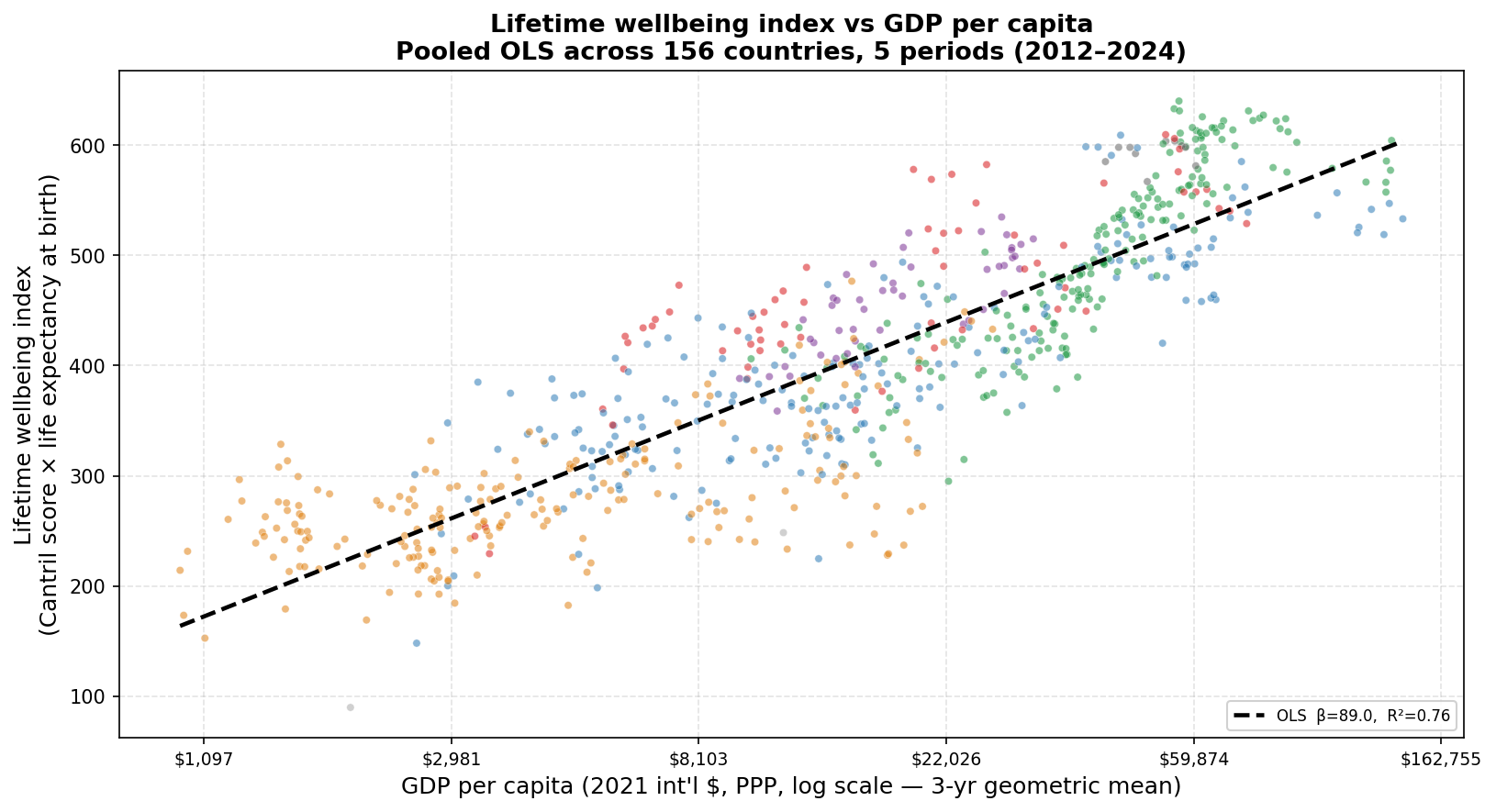
<p>The chart below plots the lifetime wellbeing index against mean log GDP per capita across all 733 country-period observations.</p>

<p><img src="/assets/images/lifetime_wb_01_scatter.png" alt="Pooled scatter of lifetime wellbeing index vs log GDP per capita, 156 countries, 5 periods" /></p>

<p><em>Each point is a country-period. Colors denote world region. The dashed line is pooled OLS (β = 89.0, R² = 0.76).</em></p>

<p>The pooled OLS slope is 89.0 index points per log-point of GDP, meaning a doubling of GDP per capita is associated with roughly 62 additional units on the lifetime wellbeing index. This could be, for example, an extra decade of life with a Cantril score of 6.2, or an increase of 1 point on the Cantril scale for someone with a life expectancy of 62 (or some combination of the two). The R² of 0.76 is higher than the 0.64 obtained when regressing the Cantril score alone on log GDP, reflecting that income is correlated with both reported wellbeing and life expectancy, so the composite index is more tightly organized around the income gradient.</p>

<h2 id="within-country-trendlines">Within-country trendlines</h2>

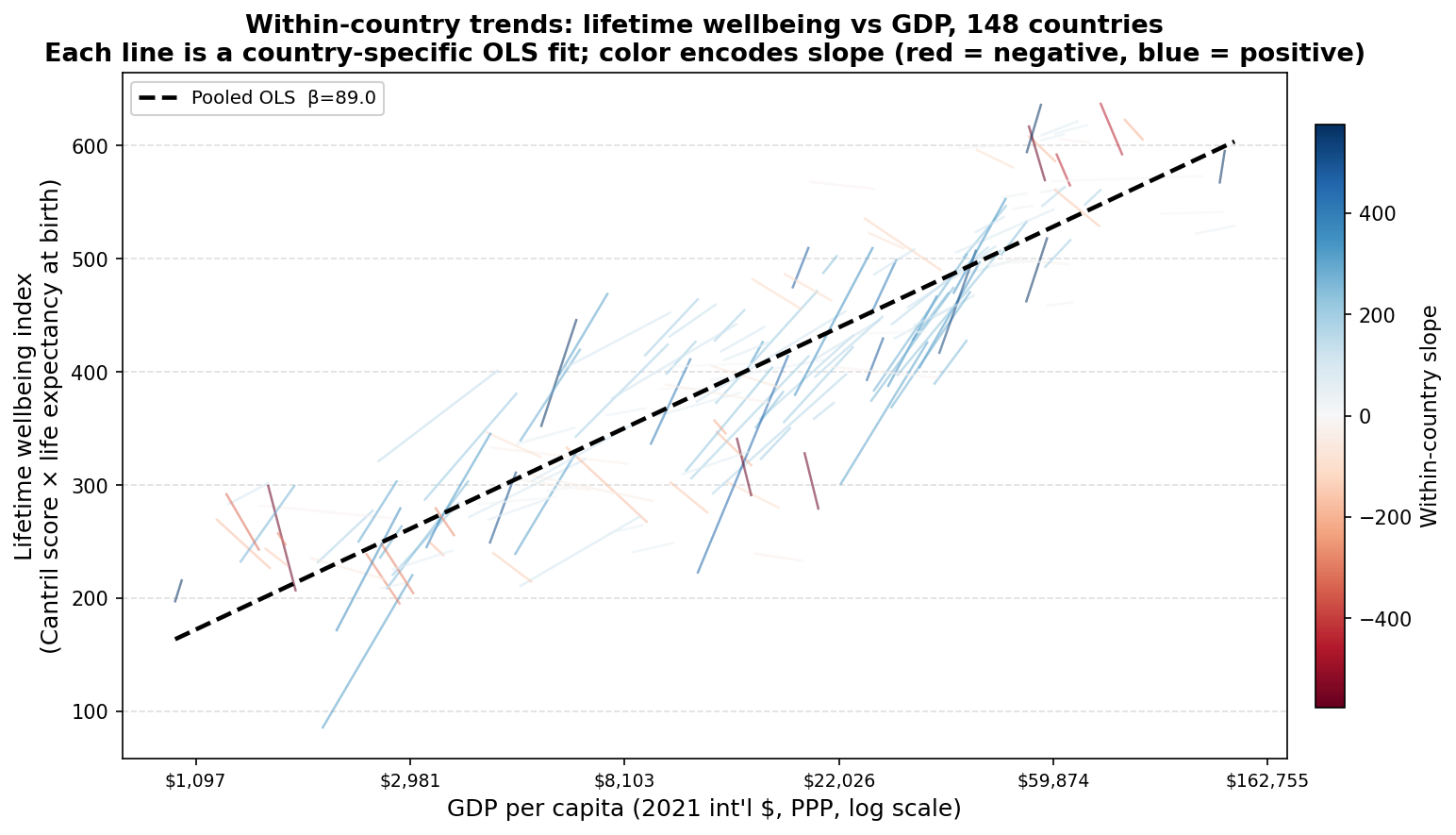
<p>The chart below shows a country-specific OLS fit for each of the 148 countries with at least three period observations. Each line spans that country’s range of mean log GDP per capita across its observed periods. Color encodes the within-country slope: red lines slope downward, blue lines slope upward.</p>

<p><img src="/assets/images/lifetime_wb_02_trendlines.png" alt="Within-country OLS trendlines colored by slope, lifetime wellbeing vs GDP, 148 countries" /></p>

<p><em>Each line is a country-specific OLS fit. The dashed black line is the pooled OLS from the chart above. Color encodes within-country slope (red = negative, blue = positive).</em></p>

<p>Of the 148 countries, 107 (72%) have positive within-country slopes. The median within-country slope is 97.1. For comparison, the same calculation on the Cantril score alone yields 59% positive slopes and a median slope of 1.0. The regional pattern broadly mirrors the happiness-only analysis: European countries cluster in the upper-right with predominantly blue lines, while African countries span a wider range of slopes and contribute more of the negative-slope lines.</p>

<h2 id="distribution-of-within-country-slopes">Distribution of within-country slopes</h2>

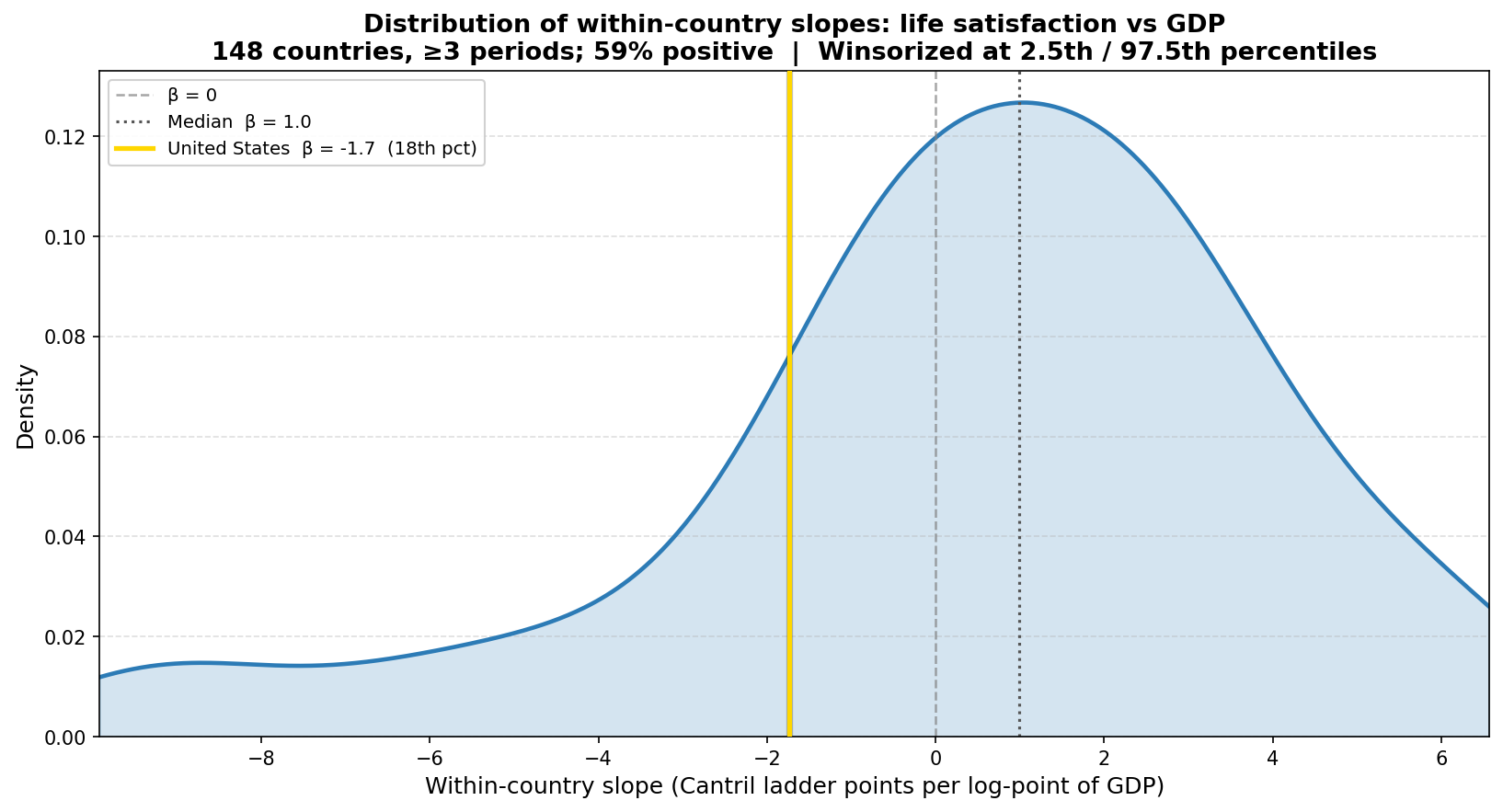
<p>The two charts below show the full distribution of within-country slopes — first for the Cantril score alone, then for the lifetime wellbeing index — using the same design for direct comparison.</p>

<p><img src="/assets/images/lifetime_wb_03_kde_happiness.png" alt="KDE of within-country slopes, Cantril score vs GDP, USA marked" /></p>

<p><em>Kernel density estimate of within-country Cantril slopes. The gold line marks the United States (β = −1.7, 18th percentile). The dashed gray line marks β = 0. Winsorized at 2.5th/97.5th percentiles.</em></p>

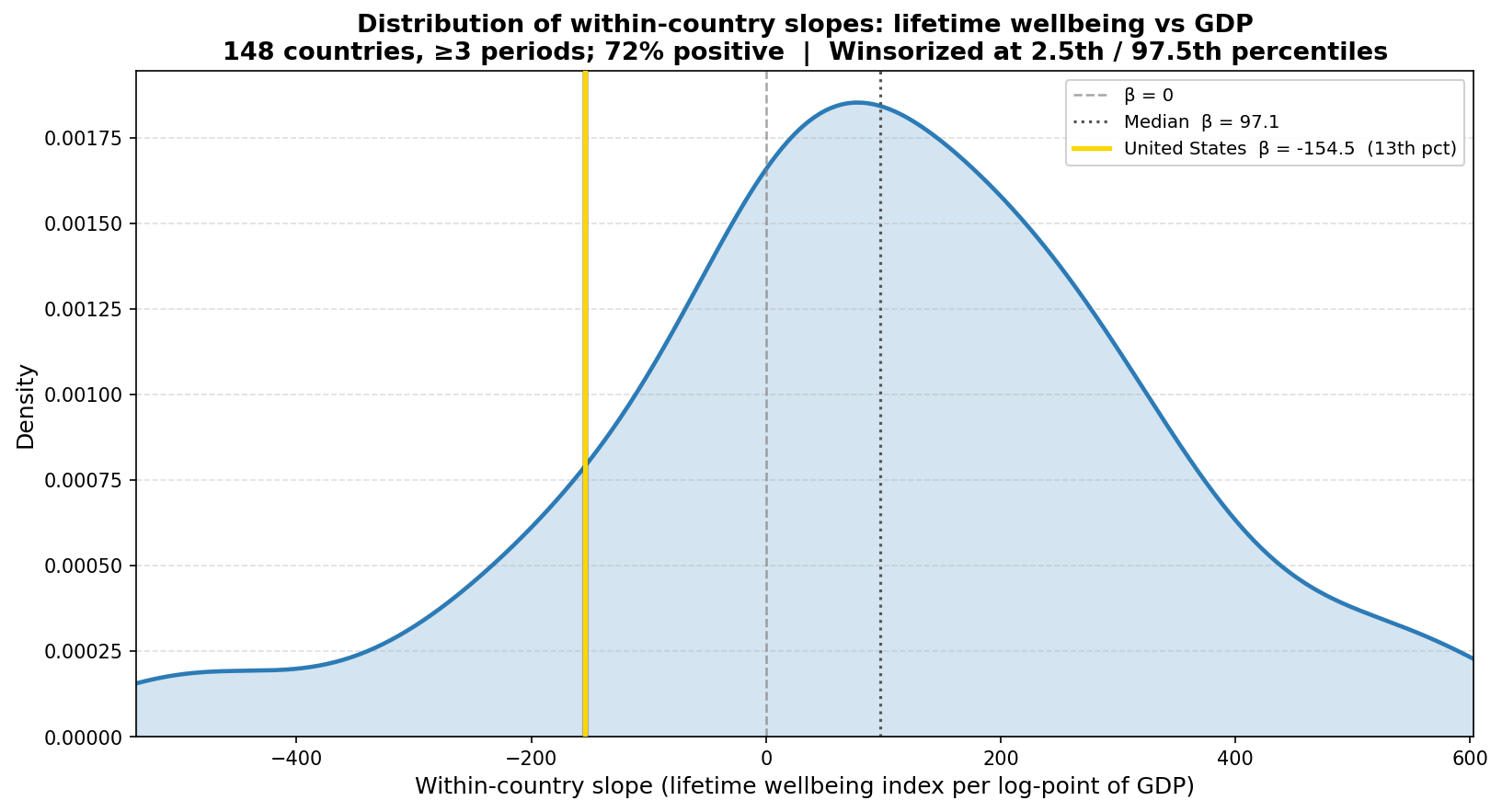
<p><img src="/assets/images/lifetime_wb_04_kde_lifetime.png" alt="KDE of within-country slopes, lifetime wellbeing index vs GDP, USA marked" /></p>

<p><em>Kernel density estimate of within-country lifetime wellbeing slopes. The gold line marks the United States (β = −154.5, 13th percentile). The dashed gray line marks β = 0. Winsorized at 2.5th/97.5th percentiles.</em></p>

<p>The happiness-only distribution has a median of 1.0 and 59% positive slopes. The lifetime wellbeing distribution has a median of 97.1 and 72% positive slopes. The x-axis scales are not comparable (the units differ by roughly a factor of life expectancy), but the shape of each distribution and the position of the United States within it can be read directly.</p>

<p>The United States has a within-country Cantril slope of −1.7 (18th percentile) and a within-country lifetime wellbeing slope of −154.5 (13th percentile). Its position moves slightly further into the left tail under the composite index. In the panel, US life expectancy was 78.7 years in the 2012 period and 78.6 years in the 2024 period, a near-zero change, while the cross-country median life expectancy rose from roughly 72 to 75 years across the same periods.</p>

<h2 id="decomposing-the-change-in-lifetime-wellbeing">Decomposing the change in lifetime wellbeing</h2>

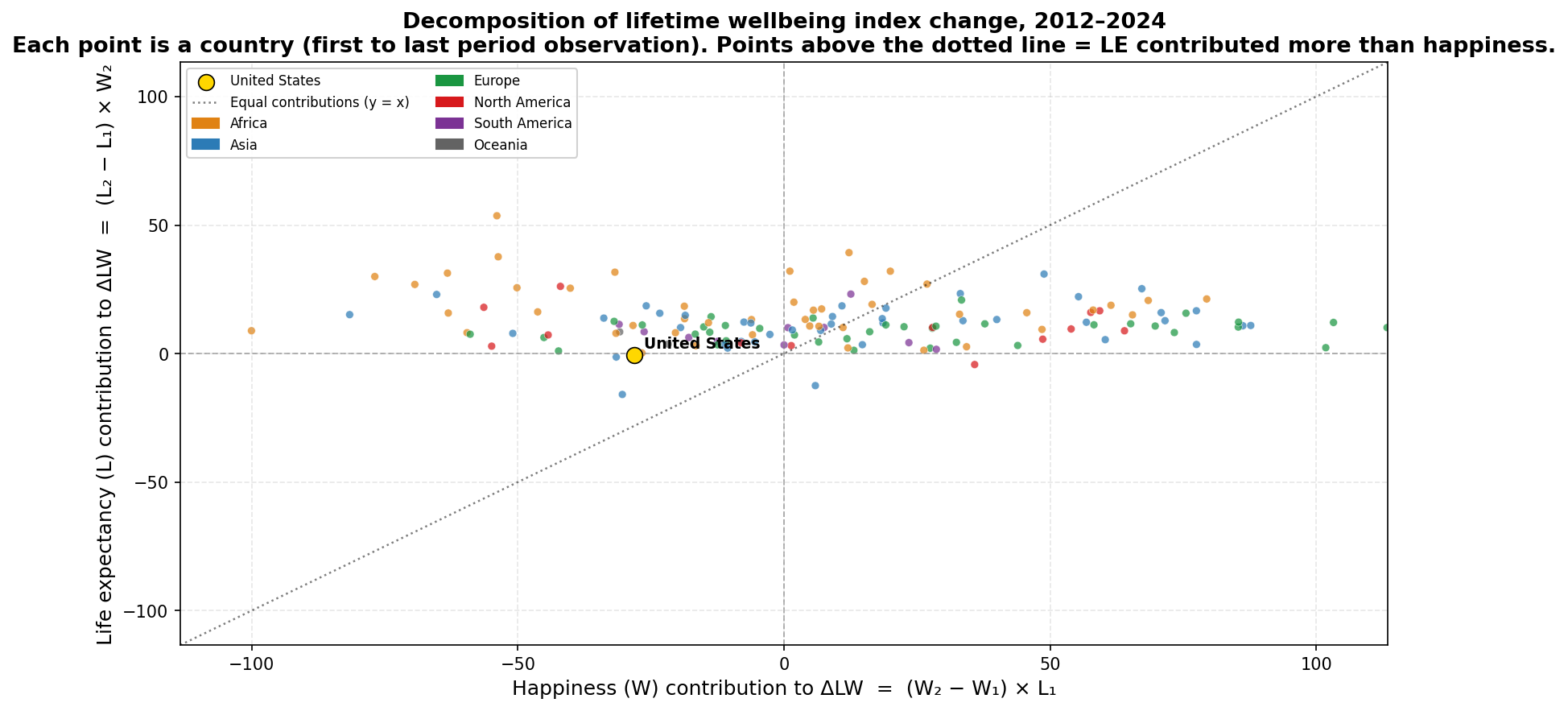
<p>The change in the lifetime wellbeing index between two periods can be decomposed exactly into a life-expectancy contribution and a happiness contribution. If a country moves from (L₁, W₁) to (L₂, W₂), the total change is:</p>

<p>ΔLW = L₂W₂ − L₁W₁ = (L₂ − L₁)W₂ + (W₂ − W₁)L₁</p>

<p>The first term, (L₂ − L₁)W₂, is how much longer life adds — the change in life expectancy weighted by the ending level of wellbeing. The second term, (W₂ − W₁)L₁, is how much happier life adds — the change in wellbeing weighted by the starting life expectancy. The two terms sum exactly to ΔLW.</p>

<p>Applying this to each country’s first and last period observation (2012 and 2024), the chart below plots the happiness contribution on the x-axis against the life expectancy contribution on the y-axis. Each point is one country. Points above the dotted equal-contribution line had LE driving more of the change; points to the right of it had happiness driving more.</p>

<p><img src="/assets/images/lifetime_wb_05_decomp_scatter.png" alt="Scatter of LE contribution vs happiness contribution to ΔLW, 155 countries" /></p>

<p><em>Each point is a country. The x-axis shows (W₂ − W₁) × L₁; the y-axis shows (L₂ − L₁) × W₂. The dotted line marks equal contributions. The United States is shown in gold.</em></p>

<p>Most countries cluster along the x-axis, below the equal-contribution line: for the typical country, changes in happiness account for more of the total LW change than changes in life expectancy. African countries (orange) sit highest on the y-axis, reflecting large LE gains over the period. The United States sits near the origin on both axes — small negative contributions from both a modest LE decline and a larger happiness decline.</p>

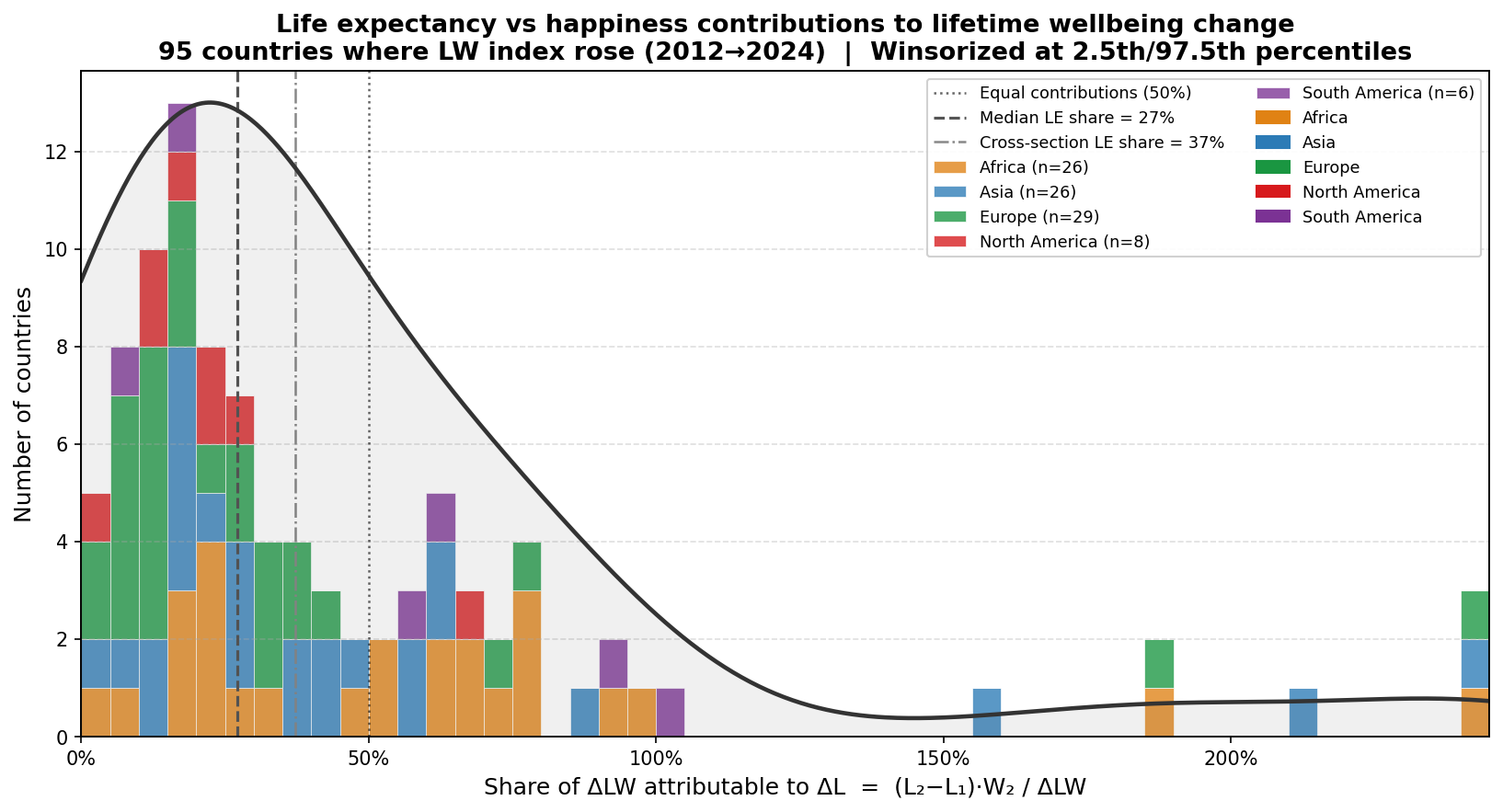
<p>The histogram below shows the distribution of the LE share — the fraction of ΔLW attributable to ΔL — among the 95 countries where the LW index rose.</p>

<p><img src="/assets/images/lifetime_wb_06_decomp_shares.png" alt="Histogram of LE share of ΔLW among countries where LW rose" /></p>

<p><em>Share of the total LW index gain attributable to the life expectancy contribution, among 95 countries where the LW index rose between 2012 and 2024. The dashed line marks the median (27%). The dot-dash line marks the share implied by the pooled cross-sectional regression decomposition (37%). Winsorized at 2.5th/97.5th percentiles.</em></p>

<p>The median LE share is 27%, meaning that for a typical country where the LW index rose, roughly three-quarters of the gain came from rising happiness and one-quarter from longer life. The cross-sectional regression decomposition — which asks how much of the relationship between log GDP and the LW index reflects the income–happiness gradient versus the income–LE gradient — gives a somewhat higher LE share of 37%. The distribution is right-skewed: the large LE gains in Sub-Saharan Africa push some countries well above 50%, and nine countries have LE shares above 100% because their happiness fell while LE rose, making the LE contribution exceed the total net change.</p>

<p>For the United States, 98% of the LW index decline between 2012 and 2024 is attributable to the happiness contribution (ΔW × L₁ = −28.2) rather than the life expectancy contribution (ΔL × W₂ = −0.6). Life expectancy was nearly flat (−0.09 years over the full period), so the entire decline in the index reflects falling reported wellbeing.</p>

<h2 id="alternative-measure-healthy-life-expectancy">Alternative measure: healthy life expectancy</h2>

<p>Total life expectancy includes all years lived, including years spent with serious illness or disability. An alternative index multiplies the Cantril score by healthy life expectancy (HALE) at birth instead. HALE subtracts years lived in poor health, weighted by severity, so it counts only years in full or near-full health. A country with total LE of 75 and HALE of 65 has ten years of expected severe morbidity; under the HALE index, those years are excluded. This measure is probably more appropriate if we think life satisfaction scores reflect experiences during healthy years of life, and less appropriate if we think life satisfaction scores are an average across a representative sample of different experiences of health in a year, for a given country.</p>

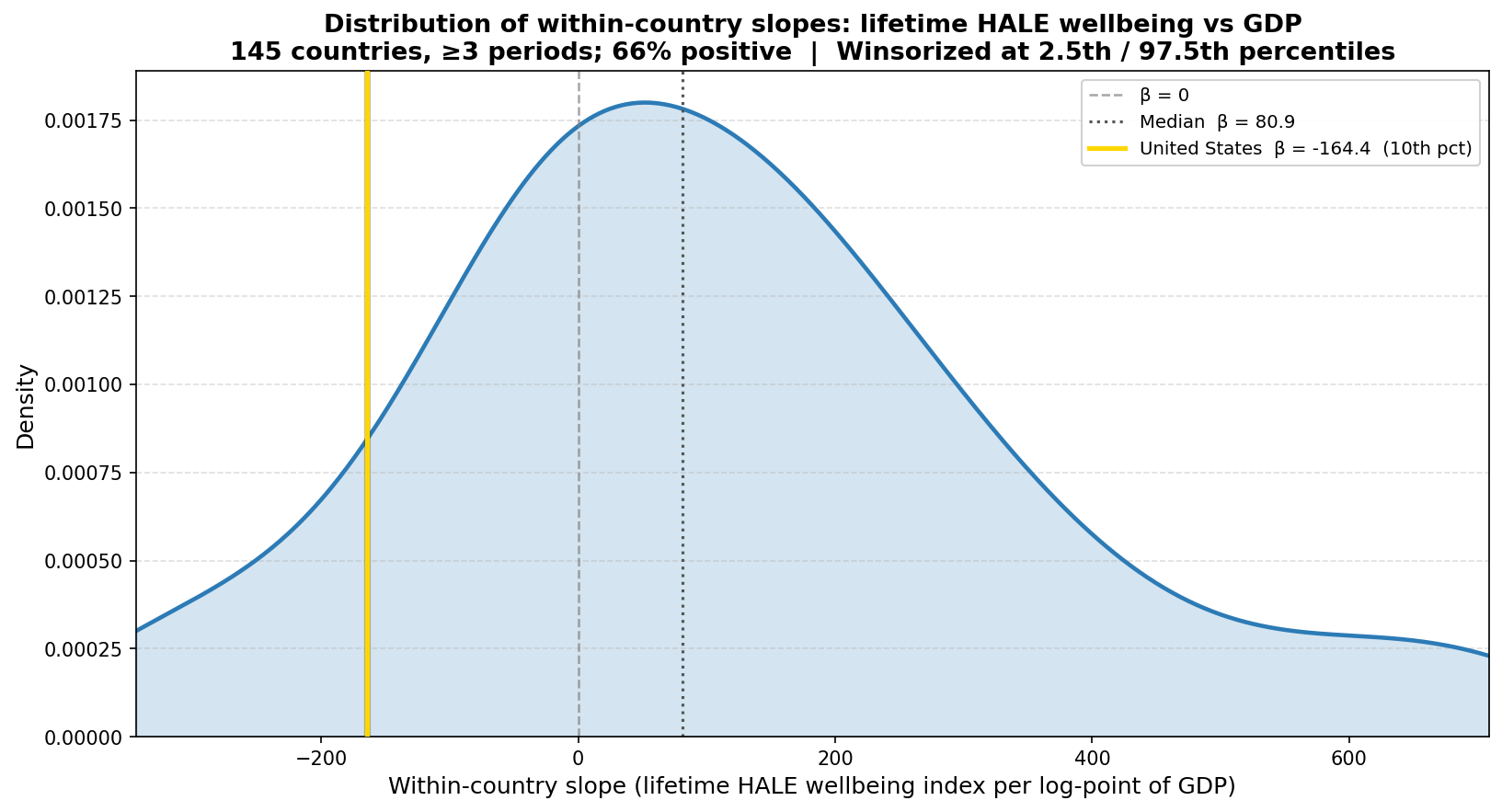
<p>Globally, the average gap between total LE and HALE in the panel is 8.7 years. For the United States, the gap is larger — 12.2 years in the 2012 period, widening to 12.6 years by 2021 — and the absolute level of US HALE declined over the panel, from 66.6 to 64.8 years.</p>

<p><img src="/assets/images/lifetime_wb_04h_kde_hale.png" alt="KDE of within-country slopes, lifetime HALE wellbeing index vs GDP, USA marked" /></p>

<p><em>Kernel density estimate of within-country HALE wellbeing slopes. The gold line marks the United States (β = −164.4, 10th percentile). The dashed gray line marks β = 0. Winsorized at 2.5th/97.5th percentiles. Based on 145 countries, four periods (2012–2021).</em></p>
<p>Under the HALE index, the distribution shifts left relative to the total-LE version: the median within-country slope falls from 97.1 to 80.9, and the share of positive slopes falls from 72% to 66%. The pooled R² is slightly lower at 0.74 versus 0.76, indicating that healthy years track the income gradient somewhat less tightly than total years of life.</p>

<p>The United States falls to the 10th percentile under HALE, compared to the 13th under total LE. The direction is consistent across both measures: the US is in the left tail of the within-country slope distribution under either index. One difference in the regional pattern: North America’s median within-country slope goes from +131.7 under total LE to −26.3 under HALE, and the majority of North American countries shift from positive to negative slopes. The Americas and Oceania show the largest reversals between the two measures; Europe and Asia are broadly stable.</p>

<p>Two caveats apply to the HALE comparison. First, the HALE analysis covers only four periods ending in 2021, which excludes the 2022–2024 window. The US Cantril score reached its low point in the 2024 period, so the four-period baseline places the US at a higher Cantril percentile (26th) than the five-period version (18th); the HALE percentile of 10th should be read in that context. Second, HALE estimates involve more modeling assumptions than total LE and may be less comparable across countries.</p>

<h2 id="reproducing-this-analysis">Reproducing this analysis</h2>

<p>The full code and data are in the <a href="https://github.com/mattsclancy/total-lifetime-wellbeing">total-lifetime-wellbeing</a> repository.</p>

<h3 id="data-1">Data</h3>

<table>
  <thead>
    <tr>
      <th>File</th>
      <th>Source</th>
      <th>Description</th>
    </tr>
  </thead>
  <tbody>
    <tr>
      <td><code class="language-plaintext highlighter-rouge">happiness-cantril-ladder.csv</code></td>
      <td>World Happiness Report / Gallup World Poll</td>
      <td>Cantril ladder score (0–10), 3-year rolling averages</td>
    </tr>
    <tr>
      <td><code class="language-plaintext highlighter-rouge">gdp-per-capita-worldbank.csv</code></td>
      <td>World Bank via Our World in Data</td>
      <td>GDP per capita, 2021 int’l $ PPP</td>
    </tr>
    <tr>
      <td><code class="language-plaintext highlighter-rouge">life-expectancy.csv</code></td>
      <td>Our World in Data</td>
      <td>Life expectancy at birth (years)</td>
    </tr>
    <tr>
      <td><code class="language-plaintext highlighter-rouge">healthy-life-expectancy-at-birth.csv</code></td>
      <td>Our World in Data</td>
      <td>Healthy life expectancy (HALE) at birth (years)</td>
    </tr>
  </tbody>
</table>

<h3 id="dependencies">Dependencies</h3>

<div class="language-plaintext highlighter-rouge"><div class="highlight"><pre class="highlight"><code>pip install pandas numpy matplotlib scipy
</code></pre></div></div>

<p>Python 3.9+.</p>

<h3 id="generating-the-charts">Generating the charts</h3>

<div class="language-plaintext highlighter-rouge"><div class="highlight"><pre class="highlight"><code>python3 lifetime_wellbeing.py        # total LE version, 5 periods
python3 lifetime_wellbeing_hale.py   # HALE version, 4 periods
python3 decomposition.py             # ΔLW decomposition charts
</code></pre></div></div>

<p>Output is saved to <code class="language-plaintext highlighter-rouge">output/</code>.</p>

<hr />

<p><em>Related: <a href="https://mattsclancy.github.io/2026/04/22/easterlin-paradox.html">Income and Happiness Across 156 Countries</a> presents the five-period panel this analysis extends — cross-sectional scatter, within-country trendlines, and two-way fixed effects for the Cantril score alone.</em></p>

<p><em>Related: <a href="https://mattsclancy.github.io/2026/04/23/us-happiness-easterlin.html">The US Happiness Decline in International Context</a> places the US within-country Cantril slope (−1.7, 18th percentile) in the international distribution and examines persistence vs mean reversion.</em></p>]]></content><author><name>Matt Clancy</name></author><category term="data" /><category term="economics" /><category term="wellbeing" /><summary type="html"><![CDATA[The Cantril ladder captures how satisfied people report feeling with their lives right now, but it says nothing about how long they live. A simple composite index — Cantril score multiplied by life expectancy at birth — adds that second dimension. This post constructs that index, plots it against GDP per capita, and examines within-country trends across the same five-period panel used in Income and Happiness Across 156 Countries. A second version of the index replaces total life expectancy with healthy life expectancy (HALE), which excludes years lived with severe illness or disability.]]></summary></entry><entry><title type="html">Does Growth Itself Raise Happiness?</title><link href="https://mattsclancy.github.io/2026/04/26/economic-growth-and-happiness.html" rel="alternate" type="text/html" title="Does Growth Itself Raise Happiness?" /><published>2026-04-26T00:00:00+00:00</published><updated>2026-04-26T00:00:00+00:00</updated><id>https://mattsclancy.github.io/2026/04/26/economic-growth-and-happiness</id><content type="html" xml:base="https://mattsclancy.github.io/2026/04/26/economic-growth-and-happiness.html"><![CDATA[<p>Income level is a powerful predictor of life satisfaction: across countries, a doubling of GDP per capita is associated with roughly half a point more on the 0–10 Cantril ladder, and the relationship holds within countries over time as well — see <a href="https://mattsclancy.github.io/2026/04/22/easterlin-paradox.html">Income and Happiness Across 156 Countries</a>. But does the <em>pace</em> of economic growth matter for happiness, above and beyond the level of income it eventually delivers? We might believe, for example, that faster growth is associated with optimism about the future, and this leads to happiness. Or we might believe that faster growth leads to less happiness, because it is disruptive to the comfortable status quo. This post asks whether countries or regions that grew faster also report higher life satisfaction once income level is held constant.</p>

<h2 id="method">Method</h2>

<p>For a given cross-section, life satisfaction is regressed on log GDP per capita to capture the level effect. The residuals from that regression — satisfaction above or below what a country’s income level predicts — are then compared against prior annualised GDP growth rates over different windows. A positive/negative slope in the residual-growth scatter would indicate that growth itself, not just the income it reaches, predicts wellbeing. A flat slope would indicate that growth only matters insofar as it raises the income level.</p>

<h2 id="international-evidence">International evidence</h2>

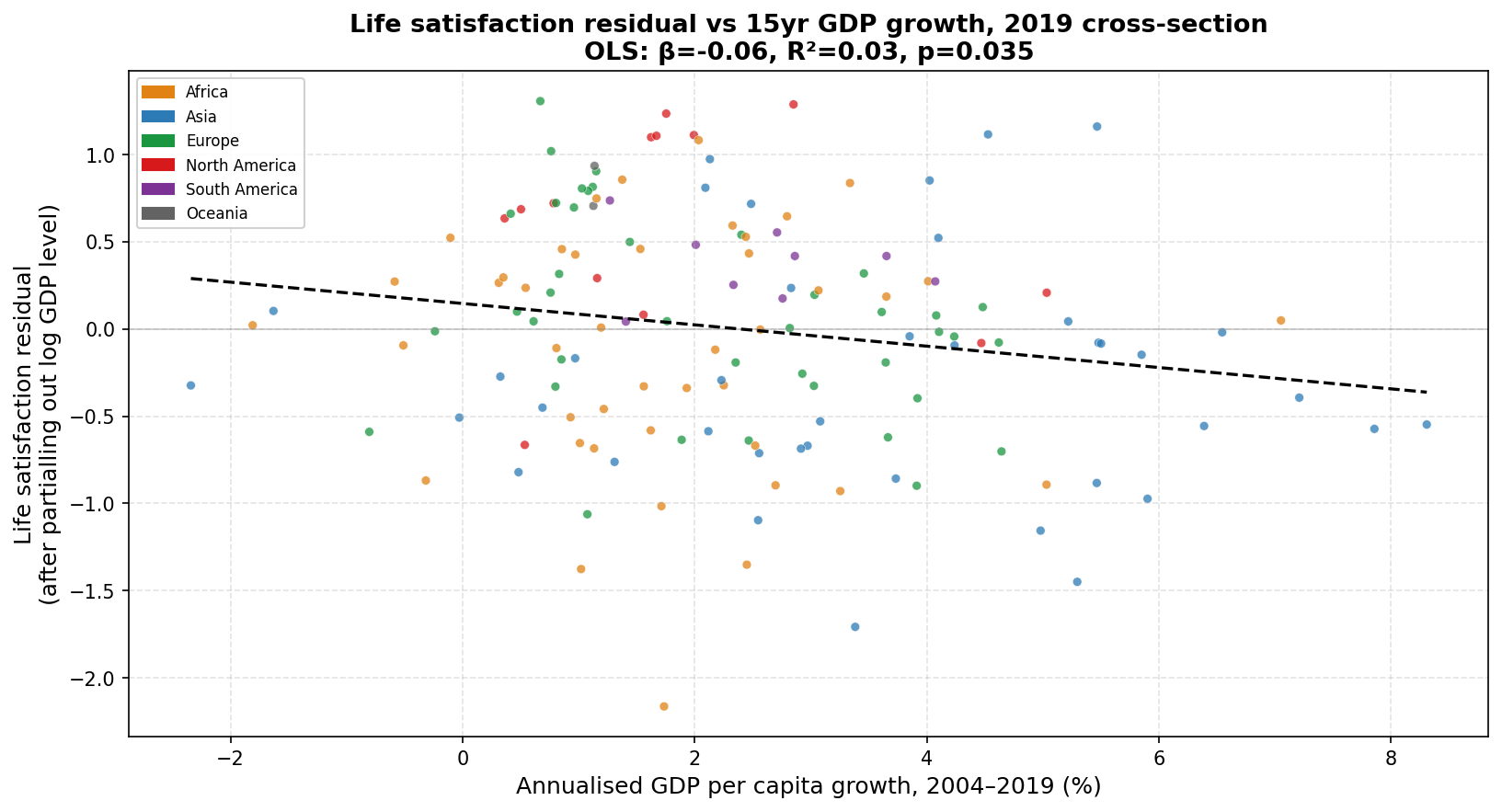
<p>Using 147 countries in 2019, log GDP per capita explains 62% of the cross-country variance in life satisfaction (β = 0.75). The chart below plots the residuals from that level regression against 15-year annualised GDP growth (2004–2019):</p>

<p><a href="/assets/images/easterlin_growth_15yr.png"><img src="/assets/images/easterlin_growth_15yr.png" alt="Life satisfaction residual vs 15yr GDP growth, 2019" /></a></p>

<p><em>Life satisfaction residuals (after removing the contribution of log GDP per capita) vs annualised GDP per capita growth, 2004–2019. OLS: β = −0.061, R² = 0.03, p = 0.035, N = 147.</em></p>

<p>The slope is weakly negative (β = −0.061): countries whose economies expanded faster over the prior 15 years reported slightly <em>lower</em> life satisfaction than their income levels would predict, not higher. The R² is 0.03 — prior growth accounts for 3% of the variance in residuals. Shorter growth windows show no relationship at all: 1-year growth (2018–2019) yields β = −0.006 (p = 0.747), and 3-year growth (2016–2019) yields β = −0.009 (p = 0.716).</p>

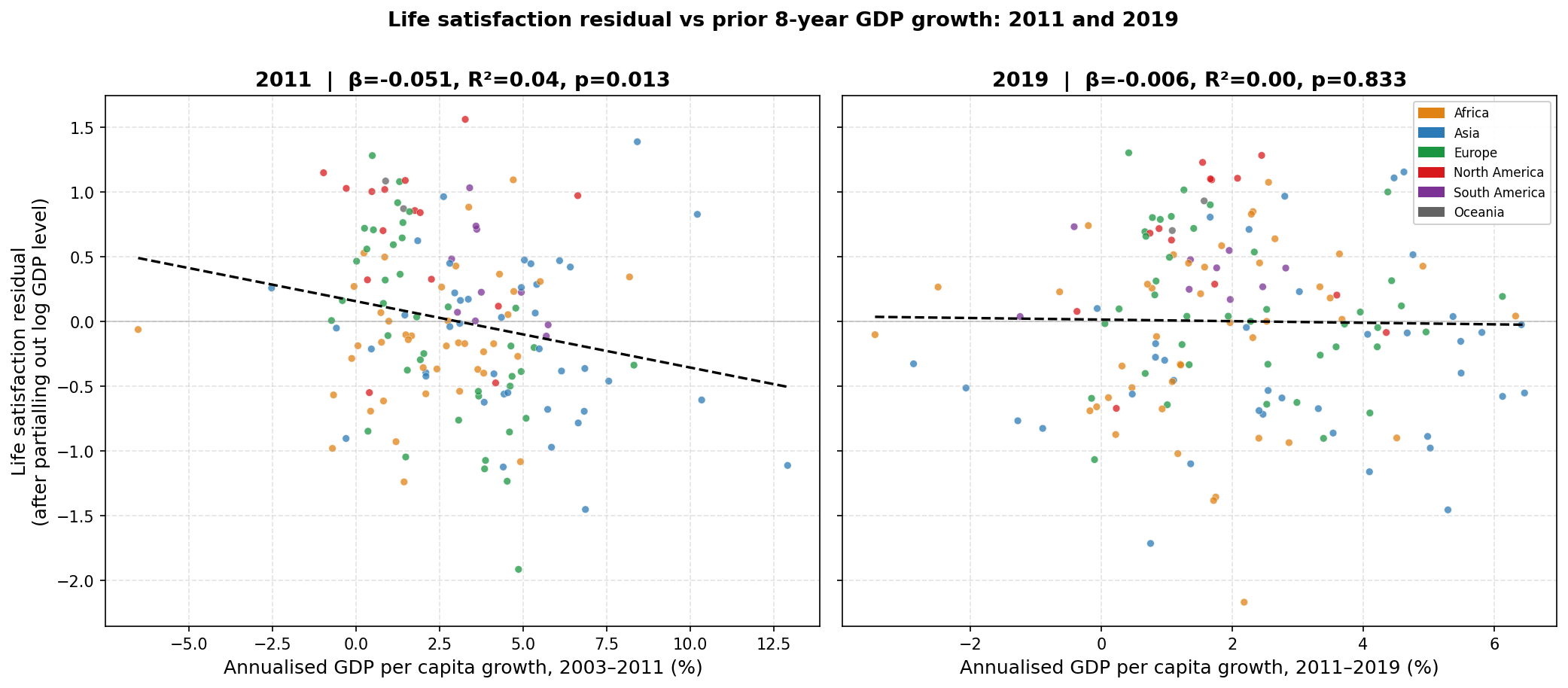
<p>The chart below repeats the exercise on two pre-COVID cross-sections — 2011 and 2019 — each matched to the prior 8 years of annualised growth:</p>

<p><a href="/assets/images/easterlin_growth_precovid.png"><img src="/assets/images/easterlin_growth_precovid.png" alt="Residuals vs prior 8yr growth, 2011 and 2019" /></a></p>

<p><em>Left: 2011 cross-section, residuals vs 2003–2011 growth (β = −0.051, R² = 0.04, p = 0.013, N = 149). Right: 2019 cross-section, residuals vs 2011–2019 growth (β = −0.006, R² = 0.00, p = 0.833, N = 148).</em></p>

<p>The 2011 cross-section shows a moderately negative slope: countries that grew rapidly in the decade before 2011 tended to report somewhat lower-than-predicted satisfaction in 2011. The 2019 cross-section is effectively flat. The difference between the two panels illustrates how unstable the relationship is across time periods. Pooling both cross-sections (N = 297):</p>

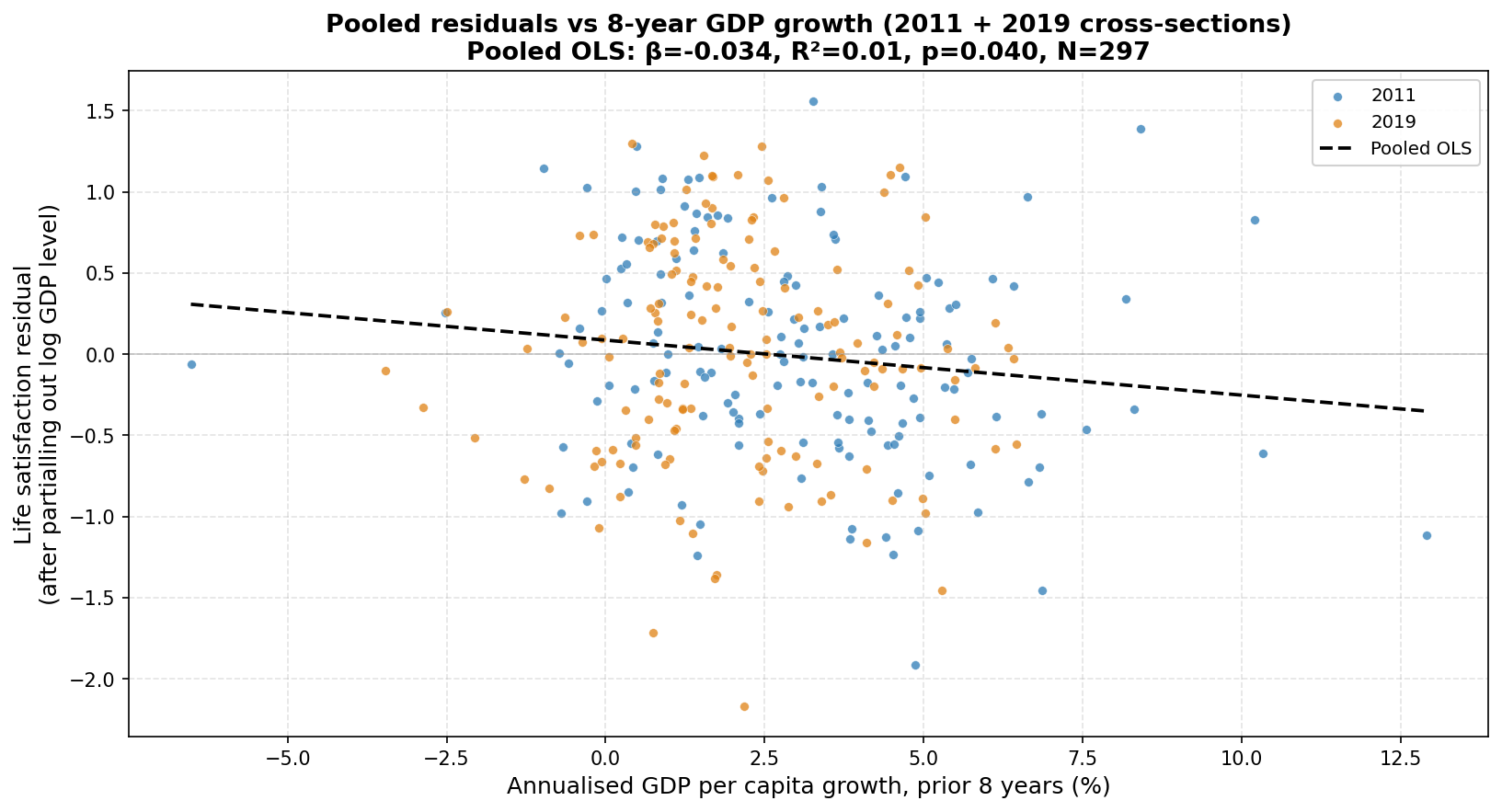
<p><a href="/assets/images/easterlin_growth_pooled.png"><img src="/assets/images/easterlin_growth_pooled.png" alt="Pooled residuals vs 8yr growth, 2011 + 2019" /></a></p>

<p><em>Pooled from 2011 and 2019 cross-sections (N = 297). Blue: 2011 observations; orange: 2019. Pooled OLS: β = −0.034, R² = 0.01, p = 0.040.</em></p>

<p>The pooled estimate is β = −0.034 (p = 0.040), marginally significant and driven substantially by the 2011 cross-section. Prior 8-year growth rates account for roughly 1% of the variance in life satisfaction residuals once income level is controlled for.</p>

<h2 id="us-regional-evidence">US regional evidence</h2>

<p>The same approach applied to the 9 US Census divisions offers an independent check using domestic data. Here, weighted average GSS happiness (on a 3–9 scale) replaces the Cantril ladder, and real per capita personal income (from BEA state data, deflated to 2017 dollars) replaces GDP.</p>

<p>A caveat is necessary before reading the regional results. The level-happiness relationship across Census divisions is weak — R² near zero in every cross-section — almost certainly because income variation across regions is far narrower than across countries. In 2017, the richest Census division earned 1.5× the income of the poorest; across countries in 2019, the ratio was 126×. Put in log terms, the standard deviation of log real per capita income across the 9 divisions is 0.13, compared to 1.13 across countries — an 8-fold difference in the income variation available to the regression. Within the US, individual income is strongly associated with happiness: logistic regressions on GSS microdata show that a 10% income increase is associated with a 0.43 percentage point lower probability of being “not too happy” and a 0.55 percentage point higher probability of being “very happy.” The weak regional level relationship likely reflects insufficient variation to detect what is there at the individual level, not the absence of an income-happiness link. The growth residuals reported below inherit that limitation.</p>

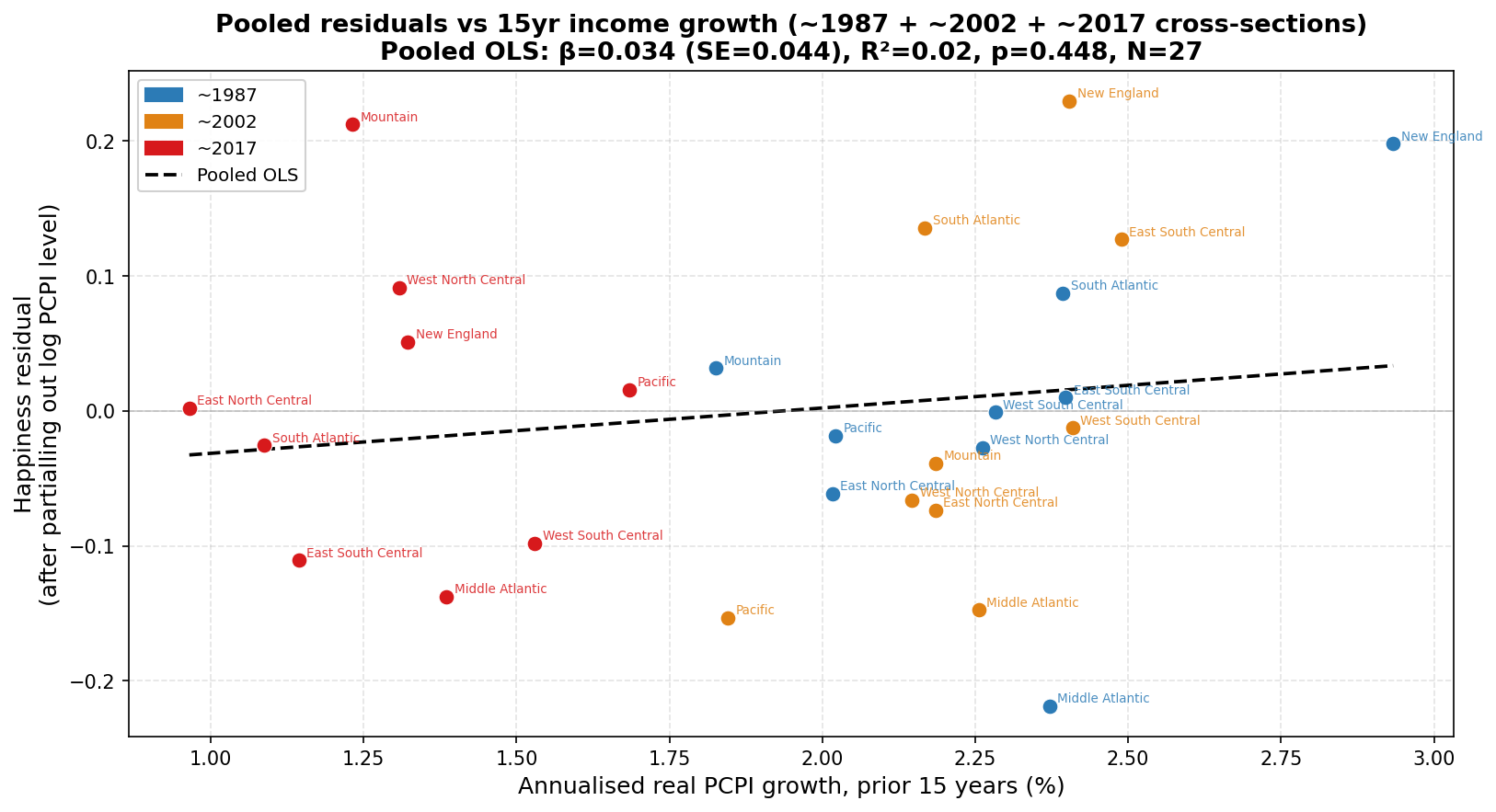
<p><a href="/assets/images/easterlin_growth_regional.png"><img src="/assets/images/easterlin_growth_regional.png" alt="Regional US pooled residuals vs 15yr income growth" /></a></p>

<p><em>Pooled from ~1987, ~2002, and ~2017 cross-sections (N = 27, 9 regions × 3 periods). Happiness residuals (after removing the contribution of log real per capita personal income) vs prior 15-year annualised income growth. Pooled OLS: β = 0.034, SE = 0.044, p = 0.448.</em></p>

<p>Three cross-sections spaced 15 years apart — happiness averaged around 1987, 2002, and 2017 — yield 27 region-period observations. The pooled slope is β = 0.034 (p = 0.448), effectively zero. The point estimate is slightly positive — the opposite sign from the international result — but far from significant. Neither direction nor magnitude supports the hypothesis that faster-growing regions report higher happiness once income level is accounted for.</p>

<h2 id="reproducing-this-analysis">Reproducing this analysis</h2>

<p>The full code and data are in the <a href="https://github.com/mattsclancy/easterlin-growth">easterlin-growth</a> repository.</p>

<h3 id="data">Data</h3>

<table>
  <thead>
    <tr>
      <th>Source</th>
      <th>Variable</th>
    </tr>
  </thead>
  <tbody>
    <tr>
      <td>World Happiness Report / Gallup World Poll</td>
      <td>Life satisfaction (Cantril ladder, 0–10)</td>
    </tr>
    <tr>
      <td>World Bank via Our World in Data</td>
      <td>GDP per capita (2021 int’l $, PPP)</td>
    </tr>
    <tr>
      <td>General Social Survey</td>
      <td>Happiness (3–9 scale), weighted by <code class="language-plaintext highlighter-rouge">wtssps</code></td>
    </tr>
    <tr>
      <td>BEA SAINC1 + FRED GDPDEF</td>
      <td>Real per capita personal income by Census division (2017 $)</td>
    </tr>
  </tbody>
</table>

<h3 id="dependencies">Dependencies</h3>

<div class="language-plaintext highlighter-rouge"><div class="highlight"><pre class="highlight"><code>pip install pandas numpy matplotlib scipy statsmodels openpyxl
</code></pre></div></div>

<hr />

<p><em>Related: <a href="https://mattsclancy.github.io/2026/04/22/easterlin-paradox.html">Income and Happiness Across 156 Countries</a> documents the income-level relationship this analysis builds on — the cross-country scatter, within-country trendlines, and two-way fixed effects.</em></p>

<p><em>Related: <a href="https://mattsclancy.github.io/2026/04/12/happiness-is-reality-minus-expectations.html">Have our expectations outpaced economic growth?</a> uses GSS data to examine how perceptions of financial wellbeing have shifted relative to income thresholds over 50 years.</em></p>]]></content><author><name>Matt Clancy</name></author><category term="data" /><category term="economics" /><category term="wellbeing" /><summary type="html"><![CDATA[Income level is a powerful predictor of life satisfaction: across countries, a doubling of GDP per capita is associated with roughly half a point more on the 0–10 Cantril ladder, and the relationship holds within countries over time as well — see Income and Happiness Across 156 Countries. But does the pace of economic growth matter for happiness, above and beyond the level of income it eventually delivers? We might believe, for example, that faster growth is associated with optimism about the future, and this leads to happiness. Or we might believe that faster growth leads to less happiness, because it is disruptive to the comfortable status quo. This post asks whether countries or regions that grew faster also report higher life satisfaction once income level is held constant.]]></summary></entry><entry><title type="html">Who Is Unhappy in America?</title><link href="https://mattsclancy.github.io/2026/04/24/who-is-unhappy-in-america.html" rel="alternate" type="text/html" title="Who Is Unhappy in America?" /><published>2026-04-24T00:00:00+00:00</published><updated>2026-04-24T00:00:00+00:00</updated><id>https://mattsclancy.github.io/2026/04/24/who-is-unhappy-in-america</id><content type="html" xml:base="https://mattsclancy.github.io/2026/04/24/who-is-unhappy-in-america.html"><![CDATA[<p>While Americans of all ages have become less happy since the 2010s (and especially since 2020), young Americans — those 35 and under — have long reported lower happiness than their elders and the gap has widened since 2010. At the same time, young people’s perception of their relative financial position has deteriorated over the entire post-war period, reversing a pattern from the 1970s in which they were the most financially optimistic age group. Financial satisfaction, by contrast, has moved more in tandem across age groups, tracking the business cycle rather than any age-specific trend.</p>

<h2 id="who-these-groups-are">Who these groups are</h2>

<p>Three age brackets — 18–34, 35–54, and 55+ — divide the weighted GSS sample into roughly equal thirds as of the early survey years, but the composition has shifted considerably. In 1972, 39% of adult respondents fell in the 18–34 bracket, 33% in 35–54, and 29% in 55+. By 2024 those shares had roughly inverted for the two outer groups: 29% are 18–34, 33% are 35–54, and 39% are 55+. Any trend that looks stable in aggregate is increasingly dominated by the experience of older Americans.</p>

<h2 id="happiness">Happiness</h2>

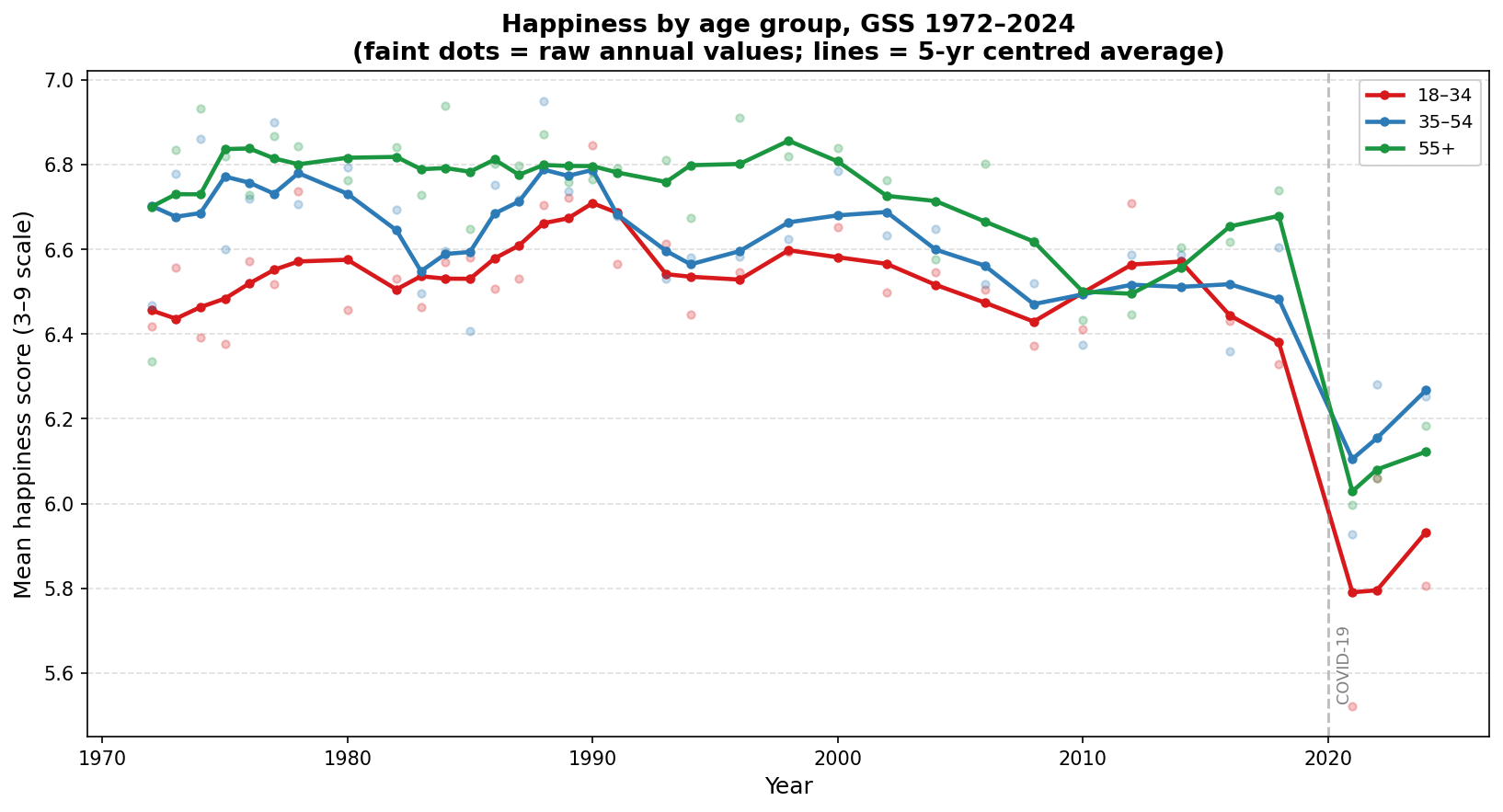
<p><a href="/assets/images/happiness_by_age.png"><img src="/assets/images/happiness_by_age.png" alt="Happiness by age group" /></a></p>

<p>From the early 1970s through the mid-2000s, the three age groups reported broadly similar happiness levels, with the 18–34 group running a modest 0.1–0.2 points below the other two on a 3–9 scale. In 1972 the gap between young adults and the average of the other two groups was effectively zero.</p>

<p>Beginning around 2012, the lines begin to separate. The decline that accelerated sharply in 2021 — visible in all three groups — hit 18–34 year olds hardest: their mean score fell from 6.33 in 2018 to around 5.5 in 2021, roughly twice the decline seen in older groups. By 2024, with some recovery, 18–34 year olds score 5.80, compared to 6.25 for the 35–54 group and 6.18 for those 55+.</p>

<p>Within the two older groups, 55+ had been the happier cohort from roughly 2000 through 2019. In 2024 the 35–54 group sits slightly above 55+, a reversal from recent years. Whether this reflects a genuine shift or is a feature of the post-pandemic recovery is not yet clear from two data points.</p>

<h2 id="perceived-financial-position">Perceived financial position</h2>

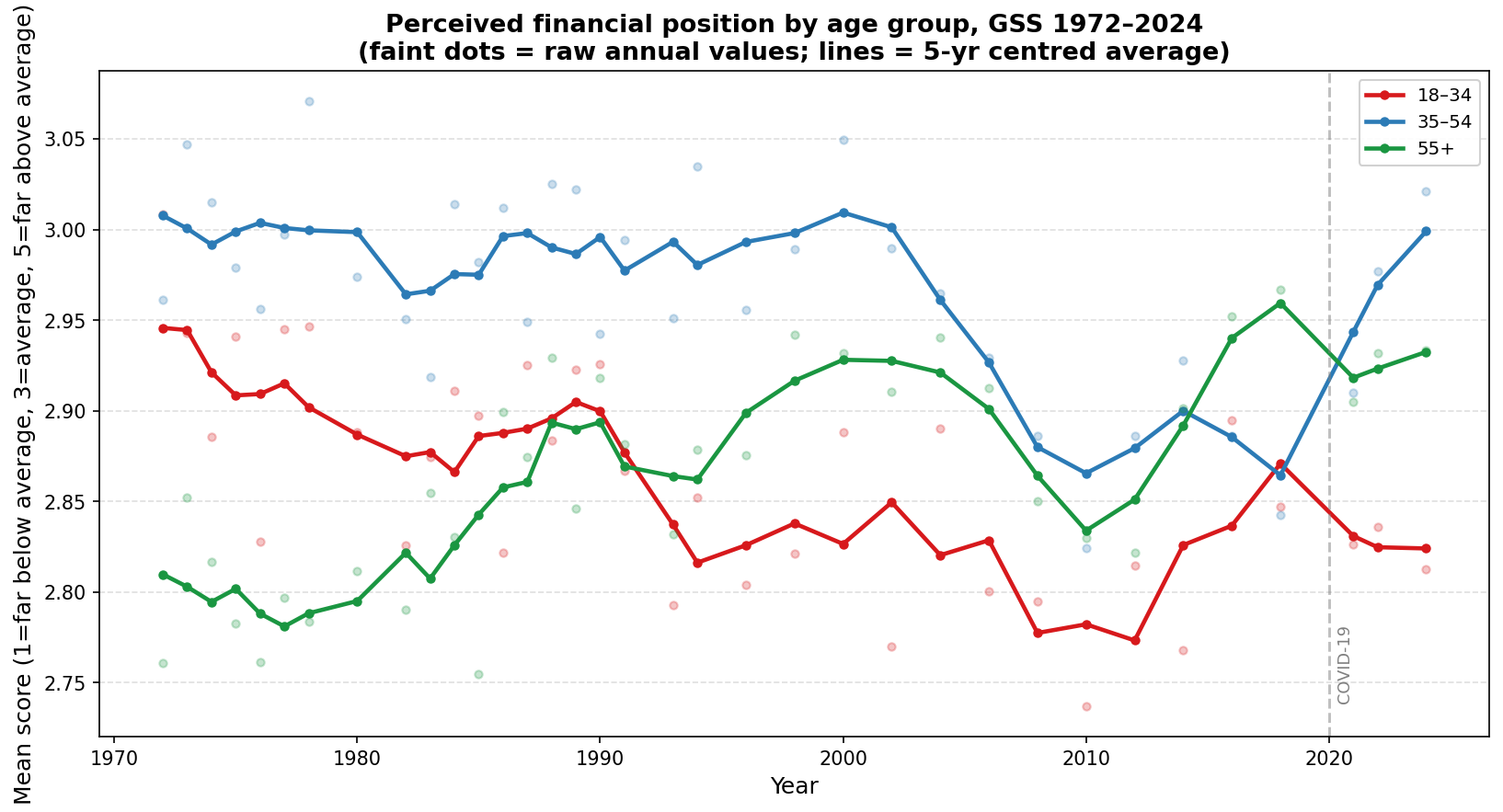
<p><a href="/assets/images/finrela_by_age.png"><img src="/assets/images/finrela_by_age.png" alt="Perceived financial position by age group" /></a></p>

<p>The GSS asks respondents whether their family income is far below average, below average, average, above average, or far above average relative to other Americans. Scored 1–5 (with 3 representing “average”), the responses reveal a striking reversal across age groups over the past half-century.</p>

<p>In 1972, 18–34 year olds rated their financial position at 3.01 — essentially average, and slightly above both the 35–54 group (2.96) and well above the 55+ group (2.76). Older Americans were the most likely to feel economically left behind. By the 2010s that ranking had fully reversed. The 55+ group has risen gradually to around 2.93, the 35–54 group recovered from a sharp dip around the 2008–2010 financial crisis back to roughly 3.0, and the 18–34 group has drifted down to 2.81 — now the lowest of the three.</p>

<p>The shift for 35–54 year olds is the most episodic: a sharp drop during the global financial crisis followed by a recovery to pre-crisis levels. The trends for the other two groups are slower-moving and directional across the entire period, with 18–34 year olds becoming steadily more pessimistic about their relative standing and 55+ year olds becoming steadily less so.</p>

<h2 id="financial-satisfaction">Financial satisfaction</h2>

<p><a href="/assets/images/financial_satisfaction_by_age.png"><img src="/assets/images/financial_satisfaction_by_age.png" alt="Financial satisfaction by age group" /></a></p>

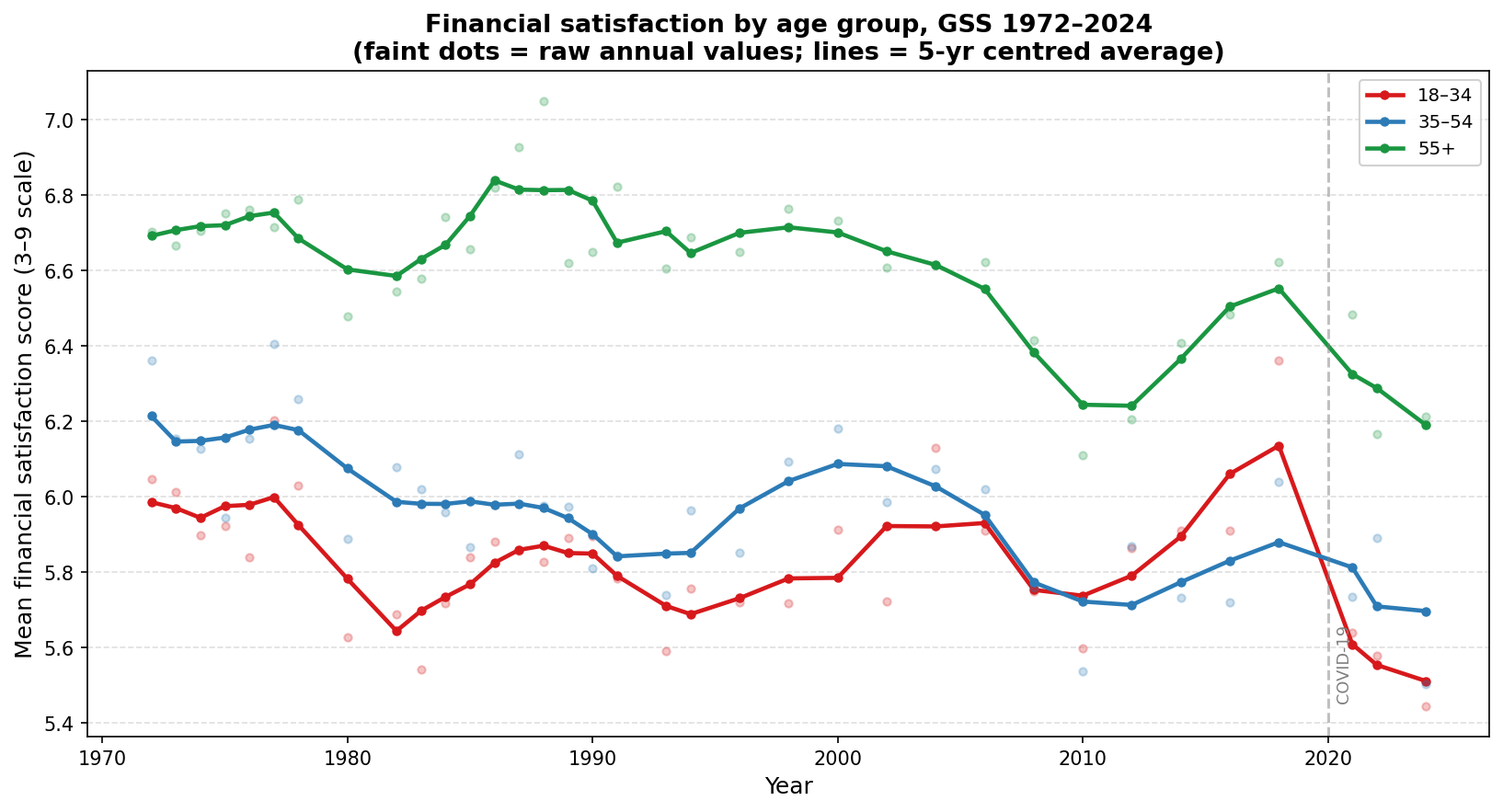
<p>Satisfaction with one’s financial situation (scored 3–9, from “not satisfied at all” to “pretty well satisfied”) tells a different story. Here the 55+ group has been the most satisfied throughout the entire series, the 35–54 group intermediate, and 18–34 the least satisfied — a ranking that has been stable since the 1970s, with no notable change in the gaps between groups.</p>

<p>What moves financial satisfaction is primarily the business cycle. All three groups dipped in the early 1980s recession and again around 2010, and all three registered a sharp drop in 2021 before partial recovery. Unlike the finrela series, there is no clear secular divergence between age groups; the lines shift roughly in parallel. The 2024 readings — 5.44 for 18–34, 5.50 for 35–54, and 6.21 for 55+ — are near the low end of the historical range for all three groups.</p>

<p>The contrast with the finrela chart is worth noting directly. The two questions measure related but distinct things: finrela asks how you compare to others, while satfin asks how satisfied you are in absolute terms. A young person who sees themselves as below average relative to peers (finrela) may still report moderate satisfaction if their absolute standard of living is adequate, and vice versa. The divergence between the two series suggests that young adults’ growing sense of relative disadvantage has outpaced any change in their absolute financial experience.</p>

<h2 id="data">Data</h2>

<p>All estimates use the General Social Survey (GSS), weighted with <code class="language-plaintext highlighter-rouge">wtssps</code> (post-stratification weights). Happiness is scored 3/6/9 (not too happy / pretty happy / very happy). Financial satisfaction (<code class="language-plaintext highlighter-rouge">satfin</code>) uses the same scale. Perceived financial position (<code class="language-plaintext highlighter-rouge">finrela</code>) is scored 1–5 across five response categories. All charts show annual weighted means as faint dots with 5-year centered averages as the main lines.</p>

<h2 id="reproducing-this-analysis">Reproducing this analysis</h2>

<p>Data were downloaded from <a href="https://gssdataexplorer.norc.org/">GSS Explorer</a>. Code is available at <a href="https://github.com/mattsclancy/gss-happiness-by-age">mattsclancy/gss-happiness-by-age</a>.</p>

<hr />

<p><em>Related: <a href="https://mattsclancy.github.io/2026/04/19/us-happiness-wellbeing-trends.html">US happiness has fallen to record lows</a> documents the aggregate decline in American wellbeing across the GSS, the World Happiness Report, and Gallup, providing the broader context for the age-group breakdowns here.</em></p>

<p><em>Related: <a href="https://mattsclancy.github.io/2026/04/12/happiness-is-reality-minus-expectations.html">Have our expectations outpaced economic growth?</a> uses the same <code class="language-plaintext highlighter-rouge">finrela</code> and <code class="language-plaintext highlighter-rouge">satfin</code> variables to estimate the income level at which Americans begin to feel financially dissatisfied, and finds a similar post-2008 deterioration.</em></p>

<p><em>Related: <a href="https://mattsclancy.github.io/2026/04/21/gss-finrela-pessimism.html">Feeling Below Average at the Median</a> tracks the share of median-income Americans who rate their family income as below average, broken down by income band rather than age.</em></p>]]></content><author><name>Matt Clancy</name></author><category term="happiness" /><category term="gss" /><summary type="html"><![CDATA[While Americans of all ages have become less happy since the 2010s (and especially since 2020), young Americans — those 35 and under — have long reported lower happiness than their elders and the gap has widened since 2010. At the same time, young people’s perception of their relative financial position has deteriorated over the entire post-war period, reversing a pattern from the 1970s in which they were the most financially optimistic age group. Financial satisfaction, by contrast, has moved more in tandem across age groups, tracking the business cycle rather than any age-specific trend.]]></summary></entry><entry><title type="html">The US Happiness Decline in International Context</title><link href="https://mattsclancy.github.io/2026/04/23/us-happiness-easterlin.html" rel="alternate" type="text/html" title="The US Happiness Decline in International Context" /><published>2026-04-23T00:00:00+00:00</published><updated>2026-04-23T00:00:00+00:00</updated><id>https://mattsclancy.github.io/2026/04/23/us-happiness-easterlin</id><content type="html" xml:base="https://mattsclancy.github.io/2026/04/23/us-happiness-easterlin.html"><![CDATA[<p>The United States is one of 60 countries (out of 148) whose life satisfaction fell as income grew between 2010 and 2024, placing its within-country slope at the 18th percentile of the international distribution. The US is not an outlier in the cross-sectional sense — at its income level, its reported wellbeing is close to what the global trend predicts. And while its negative within-country slope is unusual, a test for mean reversion suggests the overall pattern across countries is one of persistence rather than reversion: countries above the cross-sectional happiness–income trend in 2010–15 tended to remain above it in 2016–24. The United States, which was elevated relative to trend in the first half, followed this pattern broadly — it remained above the trend in the second half, having drifted partway toward it.</p>

<p>This post draws on the same five-period panel described in <a href="https://mattsclancy.github.io/2026/04/22/easterlin-paradox.html">Income and Happiness Across 156 Countries</a>: Cantril ladder scores from the World Happiness Report at years 2012, 2015, 2018, 2021, and 2024, matched to geometric-mean GDP per capita over the corresponding three-year windows.</p>

<h2 id="the-us-in-international-context">The US in international context</h2>

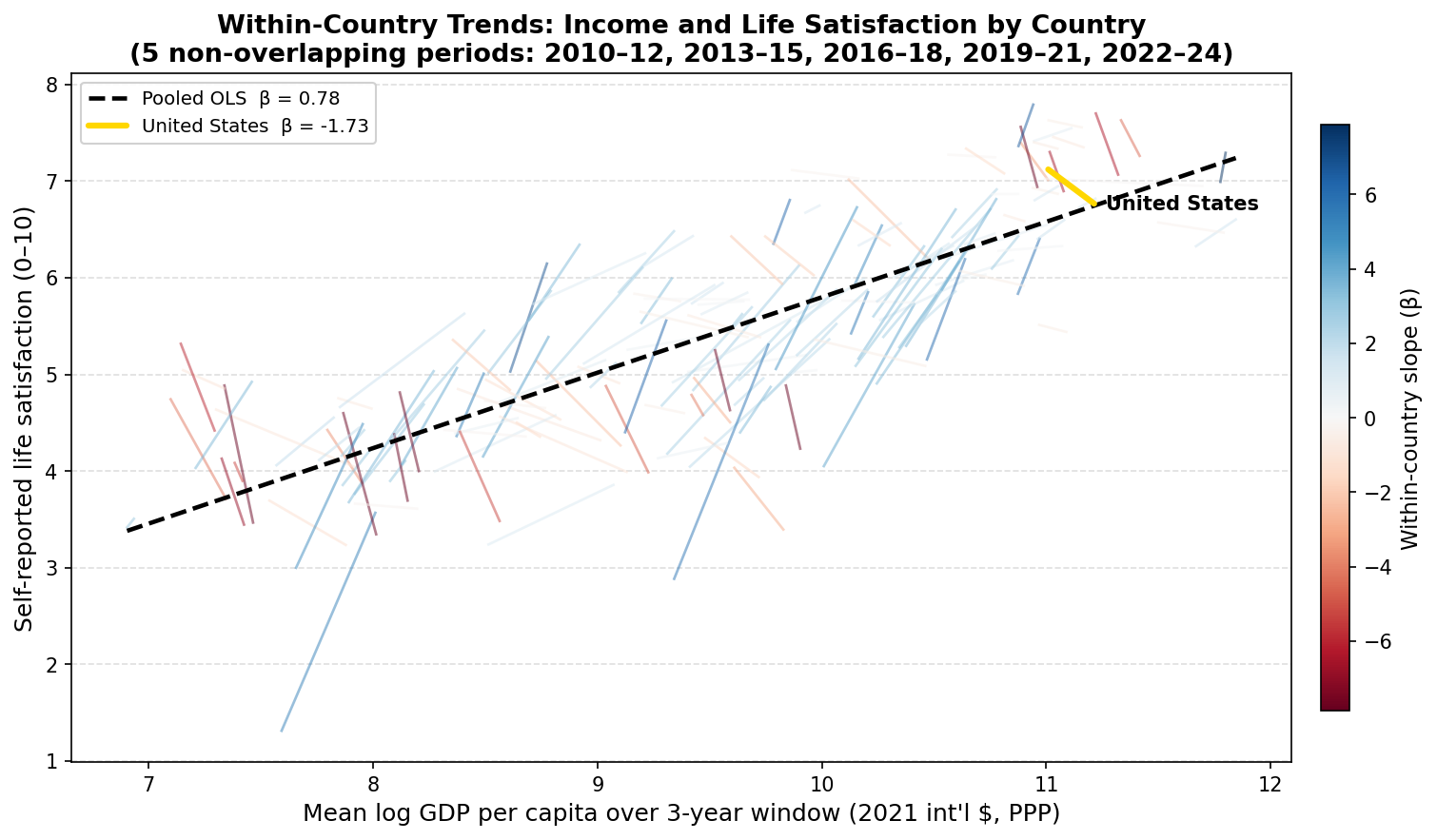
<p>The chart below shows within-country OLS trendlines for 148 countries, colored by slope direction. The United States is shown in gold.</p>

<p><img src="/assets/images/easterlin_02_trendlines_usa.png" alt="Within-country trendlines, USA in gold" /></p>

<p><em>Each line is a country-specific OLS fit across the five periods. Red lines slope downward; blue lines slope upward. The dashed black line is the pooled cross-sectional OLS (β = 0.78). The United States is shown in gold.</em></p>

<p>The US line sits in the upper-right of the chart — among the world’s highest-income countries — and slopes downward at β = −1.73, implying that a doubling of GDP per capita is associated with a 1.2-point decline in life satisfaction within the US over this period. The cross-sectional slope across all countries (the dashed pooled OLS line) is β = 0.78: a doubling of GDP per capita across countries is associated with roughly 0.54 points more life satisfaction. The US tracks close to this cross-sectional line: its average Cantril score of roughly 6.9 across the five periods is near what a country at its income level is predicted to report. The decline is in the within-country time series, not in the US’s standing relative to peers.</p>

<h2 id="distribution-of-within-country-slopes">Distribution of within-country slopes</h2>

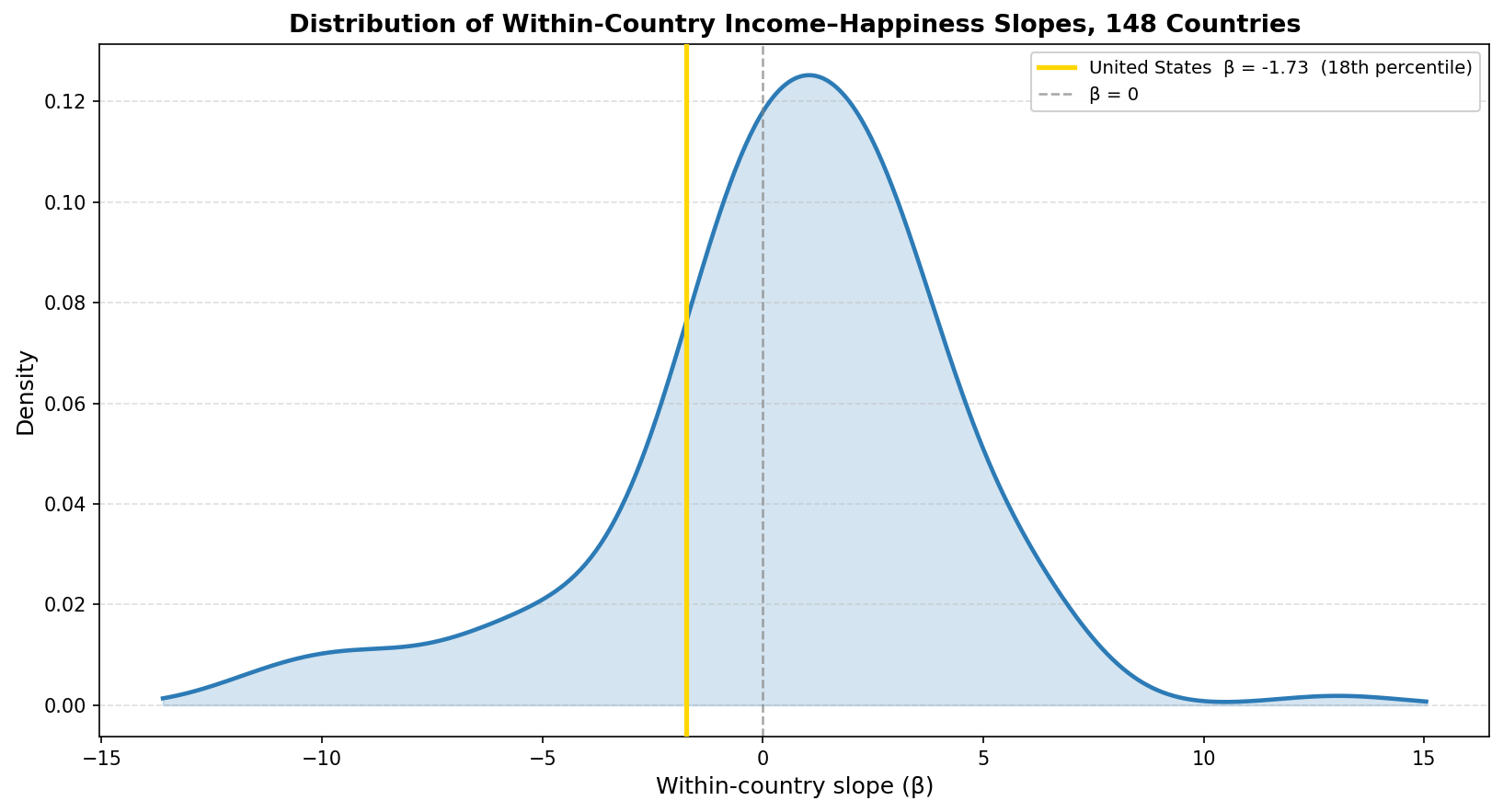
<p>The chart below shows the full distribution of within-country slopes across the 148 countries.</p>

<p><img src="/assets/images/easterlin_04_slope_kde.png" alt="KDE of within-country slopes, USA marked" /></p>

<p><em>Kernel density estimate of within-country slopes. The gold line marks the United States (β = −1.73, 18th percentile). The dashed gray line marks β = 0.</em></p>

<p>The distribution is centered well to the right of zero — the median within-country slope is 0.99, equivalent to a 0.69-point increase in life satisfaction for every doubling of GDP per capita — and 88 of 148 countries (59%) have positive slopes. The US falls in the left tail, but the distribution has substantial mass below zero. Roughly 40 countries have slopes more negative than the US.</p>

<h2 id="persistence-not-mean-reversion">Persistence, not mean reversion</h2>

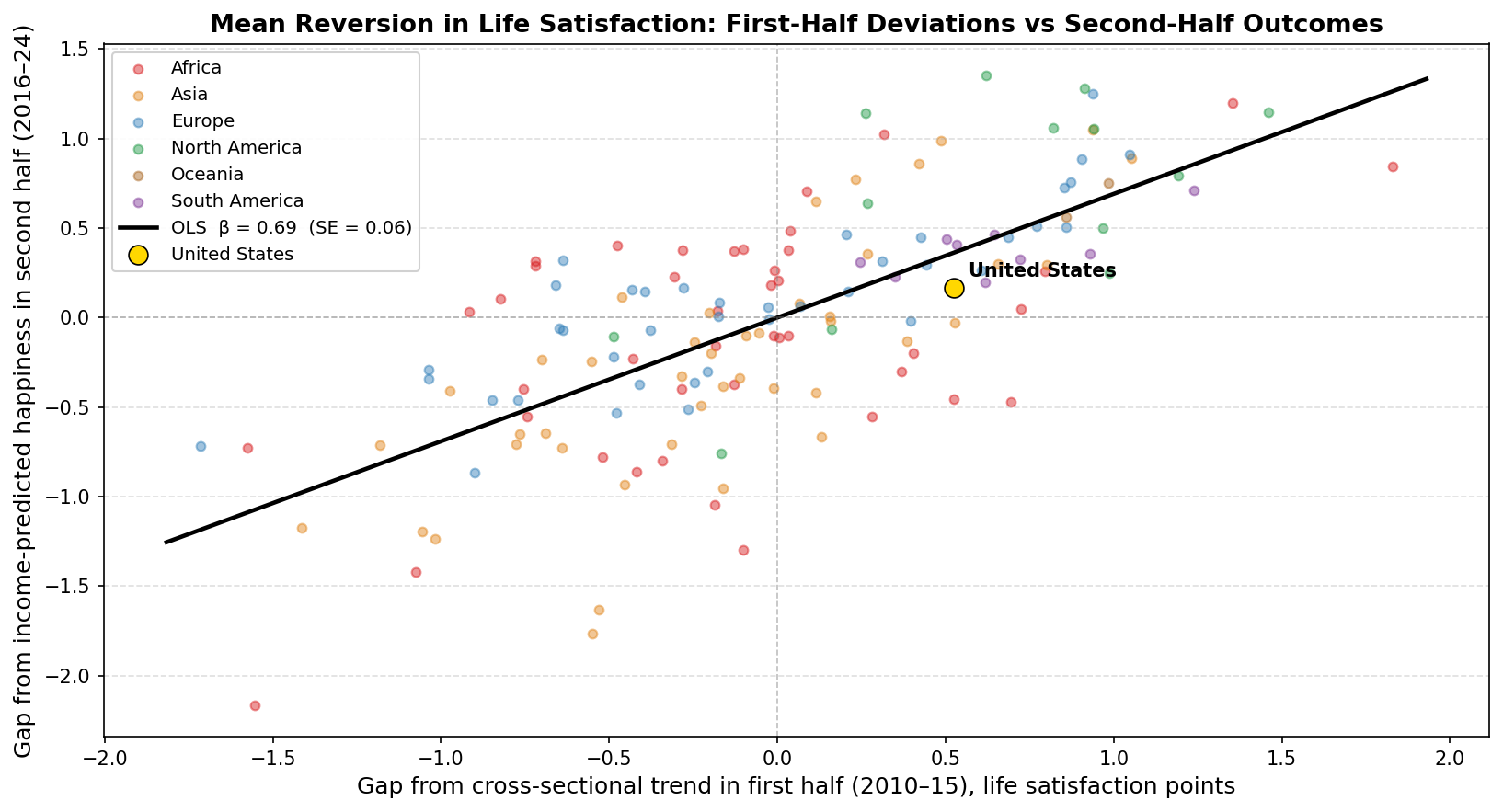
<p>One natural hypothesis is that the US began the period unusually happy for its income level, and the subsequent decline is simply regression toward the cross-sectional mean. To test this, the panel is split into a first half (periods ending in 2012 and 2015, covering 2010–15) and a second half (periods ending in 2018, 2021, and 2024, covering 2016–24). For each country, the first-half average happiness and log GDP are used to fit a cross-sectional OLS. Each country’s residual from that line — its gap above or below the 2010–15 trend — is then included as an explanatory variable in a regression of second-half happiness on second-half log GDP.</p>

<p>If the coefficient on the first-half residual is negative, countries that were above trend tended to fall back toward it — mean reversion. If it is positive, deviations from the trend tend to persist.</p>

<p>The estimated coefficient is +0.69 (SE = 0.06). Countries above the cross-sectional trend in 2010–15 tended to remain above it in 2016–24. The chart below plots this relationship directly: the x-axis is each country’s first-half gap from the trend; the y-axis is its second-half happiness after partialing out log GDP.</p>

<p><img src="/assets/images/us_easterlin_mean_reversion.png" alt="Mean reversion scatter: first-half deviations vs second-half outcomes" /></p>

<p><em>Each point is a country. The x-axis shows the gap from the 2010–15 cross-sectional trend (positive = above trend). The y-axis shows second-half life satisfaction after removing the contribution of log GDP. The black line is the OLS fit (β = 0.69, SE = 0.06). The United States is shown in gold.</em></p>

<p>The United States was 0.52 points above the cross-sectional trend in the first half — at the 75th percentile of first-half residuals. In the second half it remained 0.17 points above the income-predicted level. The persistence model predicts a second-half residual of about 0.36; the US came in at 0.17, modestly below the OLS line but still positive. The US is not a dramatic outlier in this scatter: it was elevated early, partially drifted toward the trend, and remained above it.</p>

<p>We (Claude Code and I) also tested whether the level of income explains cross-country variation in within-country slopes — whether richer countries tend to have more positive slopes. There is a weak positive correlation (R² = 0.025) that does not clear conventional significance thresholds. Income level does not meaningfully predict whether a country’s happiness grew or fell alongside its GDP over this period.</p>

<h2 id="reproducing-this-analysis">Reproducing this analysis</h2>

<p>The full code is in the <a href="https://github.com/mattsclancy/us-happiness-easterlin">us-happiness-easterlin</a> repository.</p>

<h3 id="data">Data</h3>

<p>This analysis uses the same datasets as the <a href="https://mattsclancy.github.io/2026/04/22/easterlin-paradox.html">international evidence post</a>, sourced from the World Happiness Report (Gallup World Poll Cantril ladder) and the World Bank via Our World in Data.</p>

<h3 id="dependencies">Dependencies</h3>

<div class="language-plaintext highlighter-rouge"><div class="highlight"><pre class="highlight"><code>pip install pandas numpy matplotlib scipy statsmodels
</code></pre></div></div>

<p>Python 3.9+.</p>

<h3 id="generating-the-charts">Generating the charts</h3>

<div class="language-plaintext highlighter-rouge"><div class="highlight"><pre class="highlight"><code>python3 us_analysis.py
</code></pre></div></div>

<p>Output is saved to <code class="language-plaintext highlighter-rouge">output/</code>.</p>

<hr />

<p><em>Related: <a href="https://mattsclancy.github.io/2026/04/22/easterlin-paradox.html">Income and Happiness Across 156 Countries</a> presents the full international evidence — cross-sectional scatter, within-country trendlines, and two-way fixed effects — from which the US analysis here draws.</em></p>

<p><em>Related: <a href="https://mattsclancy.github.io/2026/04/19/us-happiness-wellbeing-trends.html">US happiness has fallen to record lows</a> documents the US happiness decline in detail using GSS, World Happiness Report, and Gallup data spanning 1972–2025.</em></p>

<p><em>Related: <a href="https://mattsclancy.github.io/2026/04/24/who-is-unhappy-in-america.html">Who Is Unhappy in America?</a> breaks the US happiness decline down by age group, showing that young Americans (18–34) have experienced the sharpest fall and now report happiness well below both older cohorts and their own historical levels.</em></p>

<p><em>Related: <a href="https://mattsclancy.github.io/2026/04/27/total-lifetime-wellbeing.html">A Lifetime Wellbeing Index: Happiness Weighted by Life Expectancy</a> extends the same panel to a composite index (Cantril × life expectancy), placing the US at the 13th percentile of the within-country lifetime wellbeing slope distribution — slightly further left than its 18th-percentile position on the Cantril slope alone.</em></p>]]></content><author><name>Matt Clancy</name></author><category term="data" /><category term="economics" /><category term="wellbeing" /><summary type="html"><![CDATA[The United States is one of 60 countries (out of 148) whose life satisfaction fell as income grew between 2010 and 2024, placing its within-country slope at the 18th percentile of the international distribution. The US is not an outlier in the cross-sectional sense — at its income level, its reported wellbeing is close to what the global trend predicts. And while its negative within-country slope is unusual, a test for mean reversion suggests the overall pattern across countries is one of persistence rather than reversion: countries above the cross-sectional happiness–income trend in 2010–15 tended to remain above it in 2016–24. The United States, which was elevated relative to trend in the first half, followed this pattern broadly — it remained above the trend in the second half, having drifted partway toward it.]]></summary></entry><entry><title type="html">Income and Happiness Across 156 Countries</title><link href="https://mattsclancy.github.io/2026/04/22/easterlin-paradox.html" rel="alternate" type="text/html" title="Income and Happiness Across 156 Countries" /><published>2026-04-22T00:00:00+00:00</published><updated>2026-04-22T00:00:00+00:00</updated><id>https://mattsclancy.github.io/2026/04/22/easterlin-paradox</id><content type="html" xml:base="https://mattsclancy.github.io/2026/04/22/easterlin-paradox.html"><![CDATA[<p>Countries with higher GDP per capita report substantially higher life satisfaction: a doubling of income per head is associated with roughly half a point more on the 0–10 Cantril ladder. That cross-sectional relationship holds within countries over time as well. A two-way fixed effects regression controlling for permanent country differences and global period-to-period shifts yields a coefficient of 1.34 (clustered SE = 0.36) — larger, not smaller, than the pooled cross-sectional estimate of 0.78 (SE = 0.02).</p>

<p>The analysis uses 733 country-period observations from 156 countries across five non-overlapping periods spanning 2010–2024.</p>

<h2 id="data">Data</h2>

<p>Life satisfaction scores are from the World Happiness Report, based on the Gallup World Poll’s Cantril ladder question (0–10). Each annual observation in the underlying dataset is itself a 3-year rolling average, so consecutive rows share two years of underlying survey data. To avoid that overlap, the analysis uses five non-overlapping periods: the Cantril score at years 2012, 2015, 2018, 2021, and 2024, each representing the survey average of the preceding three calendar years. GDP per capita is from the World Bank via Our World in Data, measured in 2021 international dollars at PPP; for each period the three annual GDP values are log-transformed and averaged, giving the geometric mean GDP per capita over the window. (2013 is absent from the dataset; the World Happiness Report did not publish a 2013 edition.)</p>

<h2 id="cross-country-relationship">Cross-country relationship</h2>

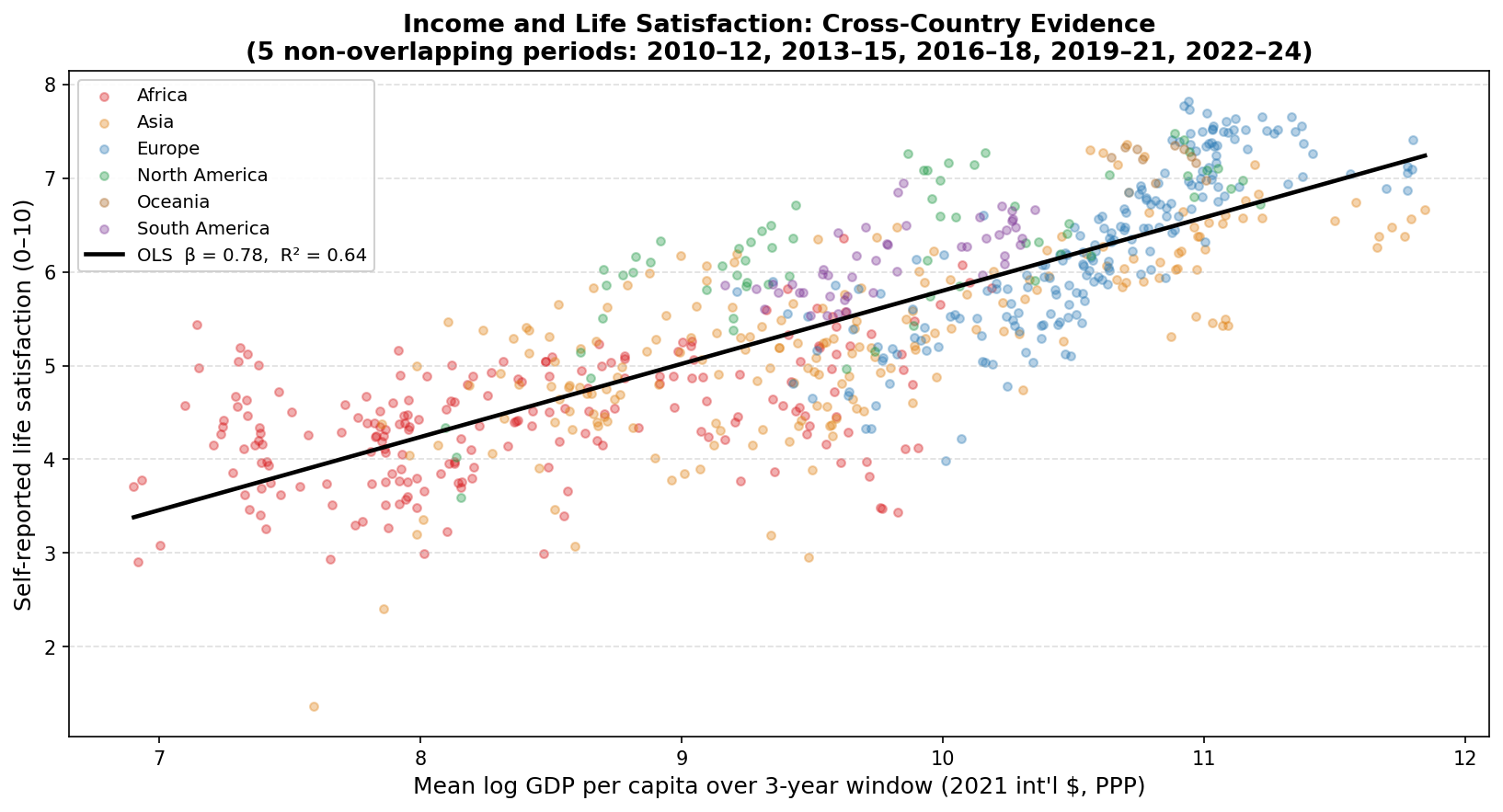
<p>The chart below pools all 733 country-period observations. Each point is one country in one period; the black line is pooled OLS.</p>

<p><img src="/assets/images/easterlin_scatter.png" alt="Pooled cross-sectional scatter of mean log GDP per capita vs life satisfaction, 156 countries, 5 periods" /></p>

<p><em>Each point is a country-period. Colors denote world region. OLS fit is pooled across all observations.</em></p>

<p>The slope of 0.78 (SE = 0.02) implies that a doubling of GDP per capita is associated with roughly 0.54 points more life satisfaction. The R² of 0.64 means log income accounts for about two-thirds of the cross-country variance in wellbeing. The relationship is consistent across regions: the fitted line passes through roughly 4.0 at log GDP of 7 (around $1,100 per capita) and 7.1 at log GDP of 11 (around $60,000 per capita). African countries, which cluster in the lower-left, and European countries, which cluster in the upper-right, both sit close to the line.</p>

<h2 id="within-country-trendlines">Within-country trendlines</h2>

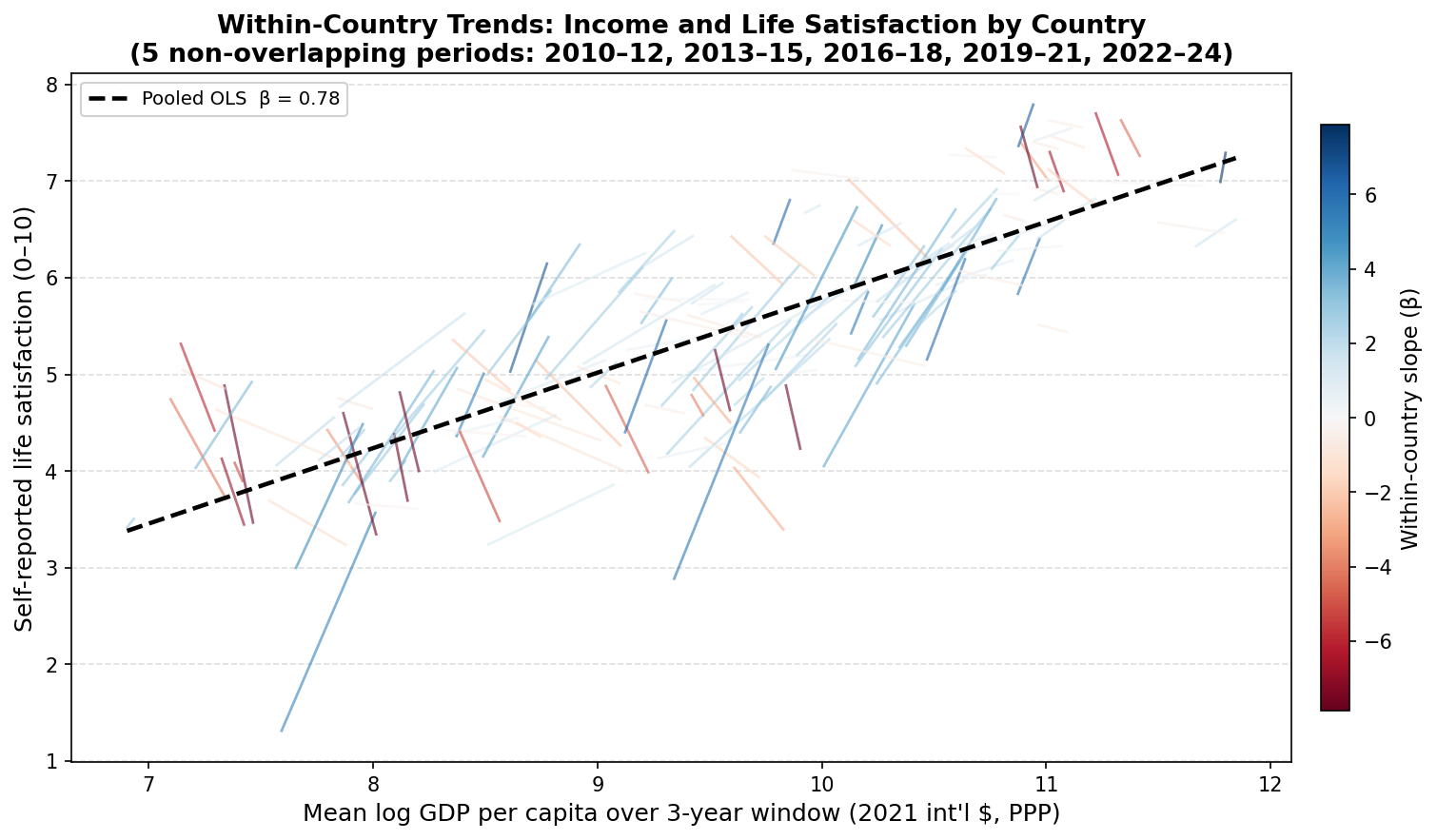
<p>The chart below replaces the single pooled line with a separate OLS fit for each of the 148 countries that have at least three period observations. Each line spans that country’s minimum-to-maximum range of mean log GDP per capita across its observed periods. Color encodes the within-country slope: red lines slope downward, blue lines slope upward.</p>

<p><img src="/assets/images/easterlin_trendlines.png" alt="Within-country OLS trendlines colored by slope, 148 countries" /></p>

<p><em>Each line is a country-specific OLS fit. The dashed black line is the pooled OLS from the chart above. Color encodes within-country slope direction and magnitude (red = negative, blue = positive).</em></p>

<p>Of the 148 countries, 88 (59%) have positive within-country slopes and 60 (41%) have negative ones. The median within-country slope is 0.99. The distribution varies by region: Europe has a median slope of 1.95 (40 countries), North America 1.42 (13 countries), South America 1.09 (9 countries), Asia 1.05 (41 countries), and Africa −0.93 (43 countries).</p>

<p>The dashed pooled OLS line (β = 0.78) sits below most of the blue country-specific lines, consistent with the TWFE result below: within-country slopes, where positive, tend to be steeper than the across-country average.</p>

<h2 id="two-way-fixed-effects">Two-way fixed effects</h2>

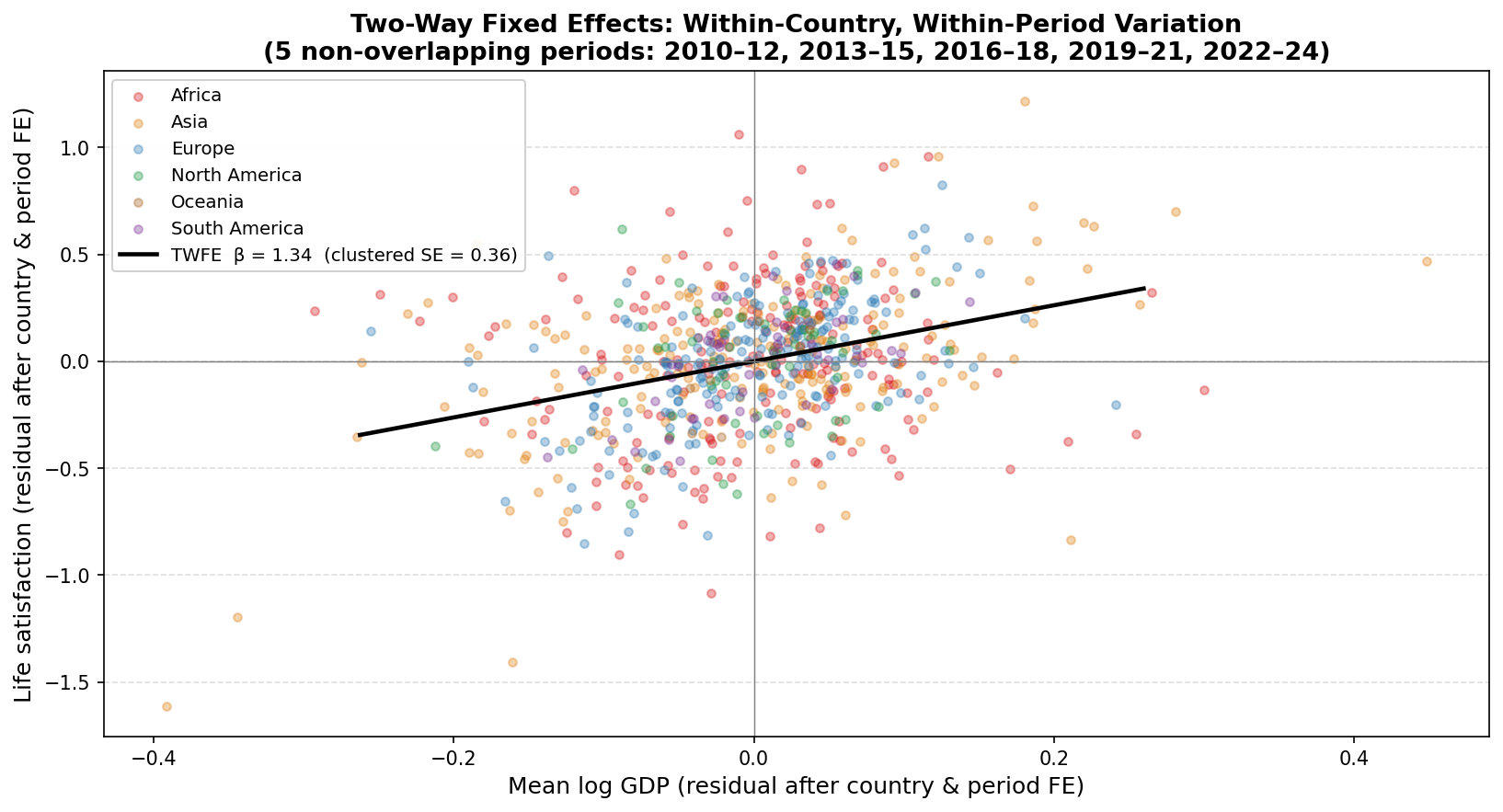
<p>The within-country trendlines above still mix two sources of variation: genuine time-series comovement within each country, and any systematic differences in income trends across countries. The two-way fixed effects (TWFE) regression isolates only within-country, within-period variation by simultaneously removing permanent country-level differences in both income and happiness, and global period-to-period shocks that affected all countries at once (for example, the 2020 Covid-19 pandemic).</p>

<p>To visualize this, both mean log GDP per capita and life satisfaction are partialed out by country and period fixed effects. The residuals from those two regressions are plotted against each other below; the TWFE slope is their OLS relationship. Standard errors are clustered by country.</p>

<p><img src="/assets/images/easterlin_twfe.png" alt="TWFE residual scatter: within-country within-period variation in log GDP vs life satisfaction" /></p>

<p><em>Each point is a country-period. Axes show residuals after removing country and period fixed effects from both variables. The black line is the TWFE estimate (β = 1.34, clustered SE = 0.36).</em></p>

<p>The TWFE coefficient is 1.34 (clustered SE = 0.36). Within a country, a period in which mean GDP per capita is 10% above that country’s baseline — after netting out the global period effect — is associated with roughly 0.13 points higher life satisfaction. A doubling of a country’s own GDP corresponds to a predicted gain of about 0.93 points.</p>

<p>The TWFE coefficient is larger than the cross-sectional estimate of 0.78. This is the opposite of the usual attenuation toward zero that fixed effects produce when confounders are positively correlated with the independent variable. One candidate explanation is short-run business cycle comovement: recessions and recoveries move income and happiness together at the country level, generating a steep within-country slope over a panel that spans both the post-2008 recovery and the COVID shock.</p>

<h2 id="reproducing-this-analysis">Reproducing this analysis</h2>

<p>The full code and data are in the <a href="https://github.com/mattsclancy/easterlin-paradox">easterlin-paradox</a> repository.</p>

<h3 id="data-1">Data</h3>

<table>
  <thead>
    <tr>
      <th>File</th>
      <th>Source</th>
      <th>Description</th>
    </tr>
  </thead>
  <tbody>
    <tr>
      <td><code class="language-plaintext highlighter-rouge">gdp-per-capita-worldbank.csv</code></td>
      <td>World Bank via Our World in Data</td>
      <td>GDP per capita, 2021 int’l $ PPP</td>
    </tr>
    <tr>
      <td><code class="language-plaintext highlighter-rouge">happiness-cantril-ladder.csv</code></td>
      <td>World Happiness Report / Gallup World Poll</td>
      <td>Cantril ladder score (0–10), 3-year rolling averages</td>
    </tr>
  </tbody>
</table>

<h3 id="dependencies">Dependencies</h3>

<div class="language-plaintext highlighter-rouge"><div class="highlight"><pre class="highlight"><code>pip install pandas numpy matplotlib scipy statsmodels
</code></pre></div></div>

<p>Python 3.9+.</p>

<h3 id="generating-the-charts">Generating the charts</h3>

<div class="language-plaintext highlighter-rouge"><div class="highlight"><pre class="highlight"><code>python3 robustness_4period/robustness_4period.py
</code></pre></div></div>

<p>Output is saved to <code class="language-plaintext highlighter-rouge">robustness_4period/output/</code>.</p>

<hr />

<p><em>Related: <a href="https://mattsclancy.github.io/2026/04/23/us-happiness-easterlin.html">The US Happiness Decline in International Context</a> applies the same five-period framework to the US specifically, placing its negative within-country slope in the distribution of 148 countries and testing whether it reflects mean reversion to the long-run cross-sectional trend.</em></p>

<p><em>Related: <a href="https://mattsclancy.github.io/2026/04/26/economic-growth-and-happiness.html">Does Growth Itself Raise Happiness?</a> extends this analysis by asking whether the *pace</em> of GDP growth predicts life satisfaction beyond the income level it reaches, across international cross-sections and US Census divisions.*</p>

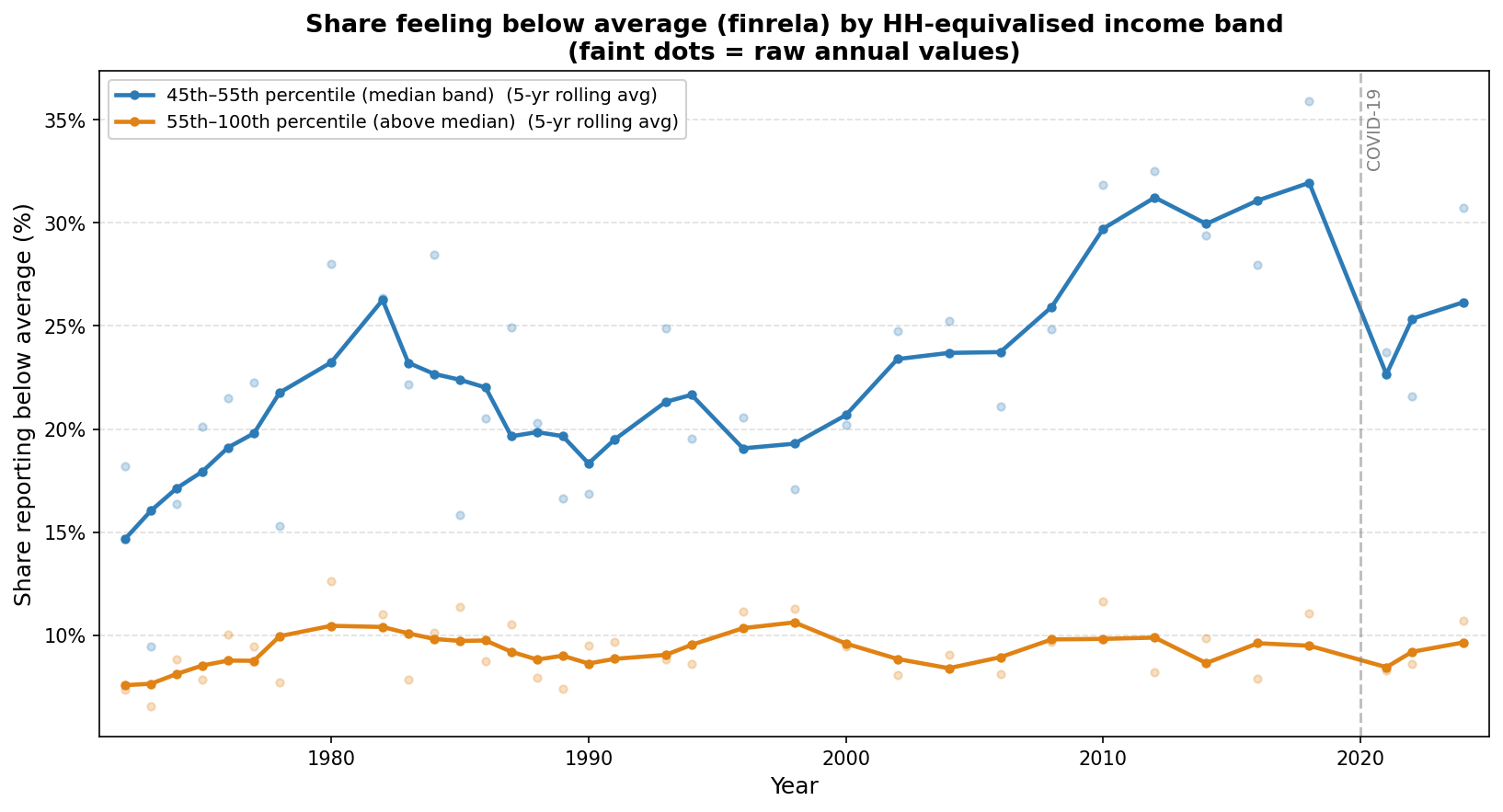
<p><em>Related: <a href="https://mattsclancy.github.io/2026/04/27/total-lifetime-wellbeing.html">A Lifetime Wellbeing Index: Happiness Weighted by Life Expectancy</a> extends the same five-period panel by multiplying the Cantril score by life expectancy at birth, examining how the cross-country and within-country income relationships change under the composite index.</em></p>]]></content><author><name>Matt Clancy</name></author><category term="data" /><category term="economics" /><category term="wellbeing" /><summary type="html"><![CDATA[Countries with higher GDP per capita report substantially higher life satisfaction: a doubling of income per head is associated with roughly half a point more on the 0–10 Cantril ladder. That cross-sectional relationship holds within countries over time as well. A two-way fixed effects regression controlling for permanent country differences and global period-to-period shifts yields a coefficient of 1.34 (clustered SE = 0.36) — larger, not smaller, than the pooled cross-sectional estimate of 0.78 (SE = 0.02).]]></summary></entry><entry><title type="html">Feeling Below Average at the Median</title><link href="https://mattsclancy.github.io/2026/04/21/gss-finrela-pessimism.html" rel="alternate" type="text/html" title="Feeling Below Average at the Median" /><published>2026-04-21T00:00:00+00:00</published><updated>2026-04-21T00:00:00+00:00</updated><id>https://mattsclancy.github.io/2026/04/21/gss-finrela-pessimism</id><content type="html" xml:base="https://mattsclancy.github.io/2026/04/21/gss-finrela-pessimism.html"><![CDATA[<p>Among Americans right at the middle of the household income distribution, the share reporting that their family income is “below average” or “far below average” has roughly doubled since the early 1970s — from around 15% to around 30%. Most of this increase occurred after 2000. Among Americans in the upper half of the income distribution, the same share has been essentially flat across five decades, holding between 8 and 11%.</p>

<p>The chart below shows both trends. The GSS <code class="language-plaintext highlighter-rouge">finrela</code> question asks respondents to place their family income relative to American families in general, on a scale from “far below average” to “far above average.” Respondents are divided into two bands each year based on their HH-equivalised household income: those in the 45th–55th percentile (the median band, in blue) and those above the 55th percentile (in orange).</p>

<p><img src="/assets/images/finrela_percentile_bands.png" alt="Share feeling below average on finrela by HH-equivalised income band, 1972–2024" /></p>

<p><em>Share of respondents reporting “below average” or “far below average” on finrela, by HH-equivalised income band. The median band (blue) covers the 45th–55th percentile of equivalised household income within each survey year; the above-median band (orange) covers the 55th–100th percentile. Lines are 5-year centred rolling averages; faint dots show raw annual values.</em></p>

<p>The above-median group (orange) is broadly stable across the entire period, oscillating between roughly 8% and 11% with no net trend. The median band (blue) is different: it starts around 15% in the early 1970s, spikes during the 1982 recession to around 30%, partially recovers through the 1990s to roughly 20%, then rises again starting around 2008 and remains elevated through the most recent waves. By the late 2010s and 2020s, the smoothed series for the median band sits near 30%.</p>

<h2 id="data">Data</h2>

<p><code class="language-plaintext highlighter-rouge">finrela</code> is a five-category GSS variable recording self-assessed financial standing relative to other American families. Household income is <code class="language-plaintext highlighter-rouge">coninc</code>, which gives constant-dollar income derived from categorical brackets, equivalised for household size using <code class="language-plaintext highlighter-rouge">hompop</code> and the OECD square-root scale (<code class="language-plaintext highlighter-rouge">coninc / sqrt(hompop)</code>). Survey weights use <code class="language-plaintext highlighter-rouge">wtssps</code>.</p>

<h2 id="reproducing-this-analysis">Reproducing this analysis</h2>

<p>The full code is in the <a href="https://github.com/mattsclancy/gss-finrela-pessimism">gss-finrela-pessimism</a> repository.</p>

<h3 id="data-1">Data</h3>

<p>The GSS data is not included in the repository. Download your own extract from <a href="https://gssdataexplorer.norc.org/">GSS Data Explorer</a> with these variables:</p>

<table>
  <thead>
    <tr>
      <th>Variable</th>
      <th>Description</th>
    </tr>
  </thead>
  <tbody>
    <tr>
      <td><code class="language-plaintext highlighter-rouge">finrela</code></td>
      <td>Opinion of family income relative to others (5 categories)</td>
    </tr>
    <tr>
      <td><code class="language-plaintext highlighter-rouge">coninc</code></td>
      <td>Family income in constant dollars</td>
    </tr>
    <tr>
      <td><code class="language-plaintext highlighter-rouge">hompop</code></td>
      <td>Number of people in household</td>
    </tr>
    <tr>
      <td><code class="language-plaintext highlighter-rouge">wtssps</code></td>
      <td>Post-stratification survey weight</td>
    </tr>
  </tbody>
</table>

<p>Save the file as <code class="language-plaintext highlighter-rouge">data/GSS.xlsx</code> in the project root. Note that <code class="language-plaintext highlighter-rouge">wtssps</code> must be added explicitly — it is not included in GSS extracts by default.</p>

<h3 id="dependencies">Dependencies</h3>

<div class="language-plaintext highlighter-rouge"><div class="highlight"><pre class="highlight"><code>pip install pandas openpyxl matplotlib
</code></pre></div></div>

<p>Python 3.9+.</p>

<h3 id="generating-the-chart">Generating the chart</h3>

<div class="language-plaintext highlighter-rouge"><div class="highlight"><pre class="highlight"><code>python3 gss_finrela_pessimism.py
</code></pre></div></div>

<p>Output is saved to <code class="language-plaintext highlighter-rouge">output/finrela_percentile_bands.png</code>.</p>

<hr />

<p><em>Related: <a href="https://mattsclancy.github.io/2026/04/12/happiness-is-reality-minus-expectations.html">Have our expectations outpaced economic growth?</a> uses the same GSS data to estimate the income level at which people begin to report financial dissatisfaction, and finds a similar post-2008 divergence from median income.</em></p>

<p><em>Related: <a href="https://mattsclancy.github.io/2026/04/19/us-happiness-wellbeing-trends.html">US happiness has fallen to record lows</a> documents the broader decline in American wellbeing across the GSS happiness question, the World Happiness Report Cantril ladder, and Gallup’s wellbeing index.</em></p>

<p><em>Related: <a href="https://mattsclancy.github.io/2026/04/24/who-is-unhappy-in-america.html">Who Is Unhappy in America?</a> breaks the <code class="language-plaintext highlighter-rouge">finrela</code> trend down by age group rather than income band, finding that young Americans have become steadily more pessimistic about their relative financial position since the 1970s while older Americans have moved in the opposite direction.</em></p>

<p><em>Data: General Social Survey, NORC at the University of Chicago, 1972–2024. Income adjusted to constant dollars and equivalised for household size (OECD square-root scale). Survey weights (wtssps) applied throughout.</em></p>]]></content><author><name>Matt Clancy</name></author><category term="data" /><category term="economics" /><category term="wellbeing" /><summary type="html"><![CDATA[Among Americans right at the middle of the household income distribution, the share reporting that their family income is “below average” or “far below average” has roughly doubled since the early 1970s — from around 15% to around 30%. Most of this increase occurred after 2000. Among Americans in the upper half of the income distribution, the same share has been essentially flat across five decades, holding between 8 and 11%.]]></summary></entry><entry><title type="html">US happiness has fallen to record lows</title><link href="https://mattsclancy.github.io/2026/04/19/us-happiness-wellbeing-trends.html" rel="alternate" type="text/html" title="US happiness has fallen to record lows" /><published>2026-04-19T00:00:00+00:00</published><updated>2026-04-19T00:00:00+00:00</updated><id>https://mattsclancy.github.io/2026/04/19/us-happiness-wellbeing-trends</id><content type="html" xml:base="https://mattsclancy.github.io/2026/04/19/us-happiness-wellbeing-trends.html"><![CDATA[<p>American happiness is near all-time lows. This isn’t a new observation, but it is one worth documenting carefully, because the evidence is stronger than any single survey or question wording can convey.</p>

<p>Across a few surveys, ways of asking, and current and future assessments of wellbeing, the picture is consistent: Americans report lower life satisfaction today than they did in the early 2000s, and well below long-run trends that are documented in the General Social Survey. COVID made it dramatically worse. Various measures of optimism about the future show similar trends.</p>

<p>This post documents those trends using data from the General Social Survey (GSS), the World Happiness Report (WHR), and Gallup’s wellbeing index.</p>

<h2 id="the-data">The data</h2>

<p>The <strong>General Social Survey</strong> has asked Americans the same question since 1972: <em>“Taken all together, how would you say things are these days — would you say that you are very happy, pretty happy, or not too happy?”</em> This is the longest consistent happiness time series available for the United States. The GSS also asks a <code class="language-plaintext highlighter-rouge">goodlife</code> question: whether respondents agree that their standard of living will improve.</p>

<p>The <strong>World Happiness Report</strong> uses the Cantril ladder, asking people to rate their current life on a 0–10 scale.</p>

<p><strong>Gallup’s wellbeing index</strong> asks Americans to rate both their current life and their anticipated life in five years on a 0–10 scale, and reports the share rating each one as high.</p>

<h2 id="happiness-is-down-across-both-scales">Happiness is down across both scales</h2>

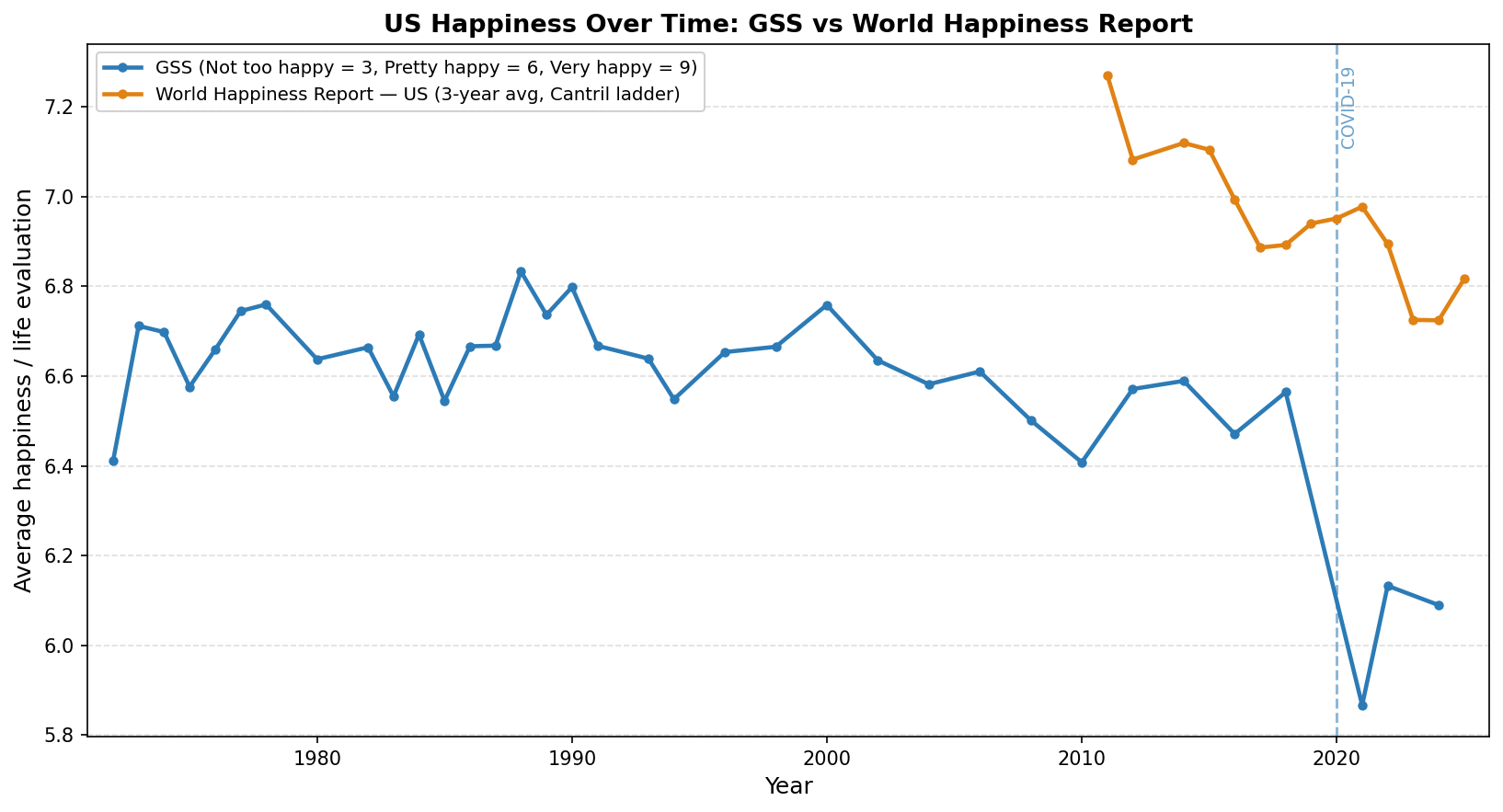
<p>The first chart plots the GSS happiness score alongside the US life evaluation from the World Happiness Report. To make the two comparable, I score the GSS responses numerically (very happy = 9, pretty happy = 6, not too happy = 3) and take the weighted average, putting the series on the same 0–10 scale as the Cantril ladder.</p>

<p><img src="/assets/images/us_happiness_trends.png" alt="GSS weighted happiness score and US life evaluation from the World Happiness Report, 1972–2025. Dashed vertical line marks 2020." /></p>

<p><em>GSS weighted happiness score and World Happiness Report US life evaluation, 1972–2025.</em></p>

<p>The long-run GSS trend was broadly stable around 6.7 from the 1970s through early 2000s, fell to around 6.5 until 2020, and then crashed to the low 6s, where it has remained. The World Happiness Report series, which only extends back to 2011, exhibits a similar pattern over a shorter window: a slide from around 7.1 in the early 2010s to a new record low of 6.7 in 2024.</p>

<h2 id="the-share-reporting-high-wellbeing">The share reporting high wellbeing</h2>

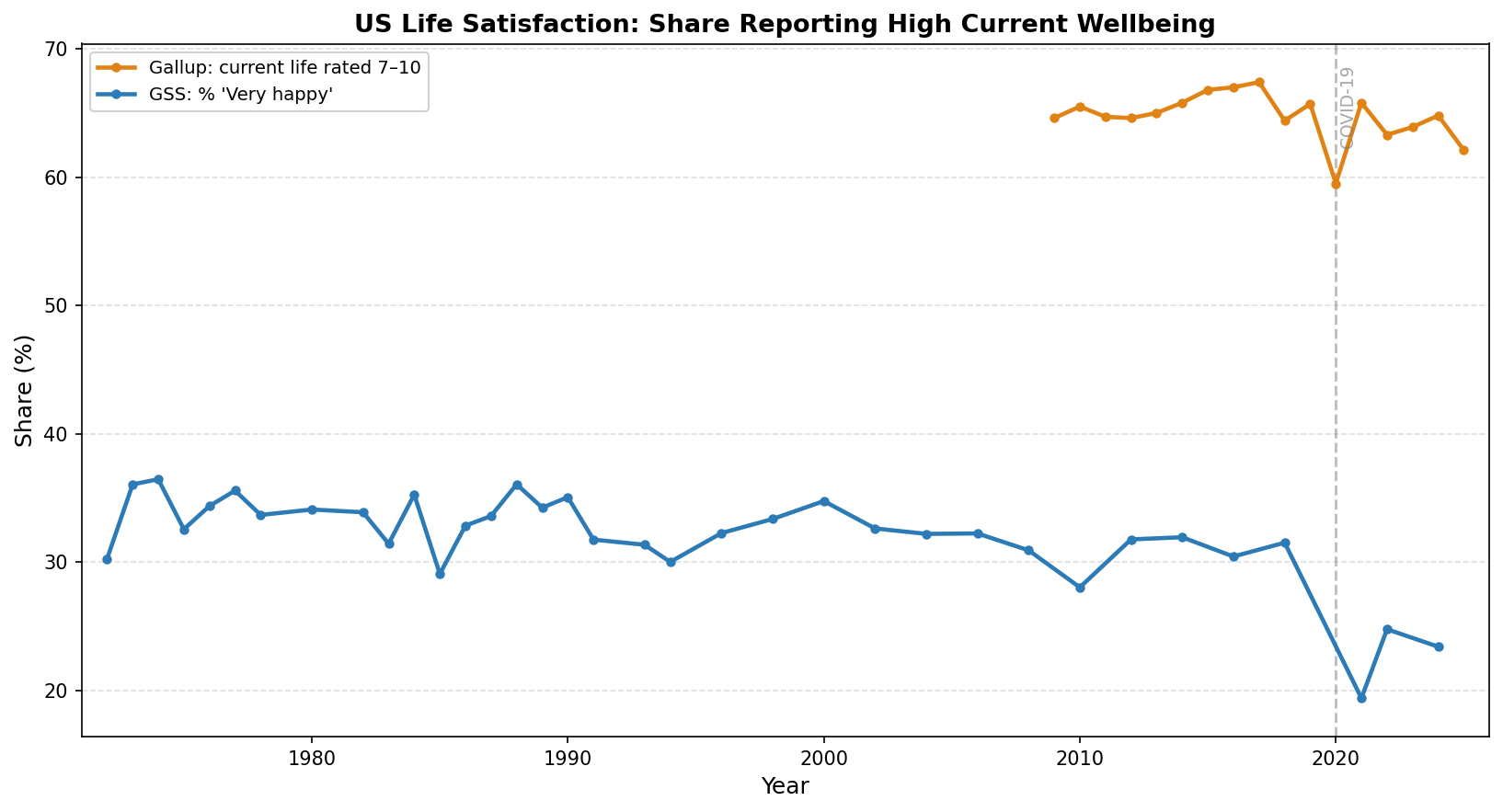
<p>Another way to look at this is to ask what share of people report being genuinely happy, rather than tracking the average score. The chart below compares two such measures: the share calling themselves “very happy” in the GSS, and the share rating their current life 7 or above on Gallup’s 0–10 scale.</p>

<p><img src="/assets/images/us_very_happy_vs_gallup.png" alt="Share of Americans reporting high current wellbeing: % answering &quot;Very happy&quot; (GSS) vs % rating current life 7–10 (Gallup). Both plotted on a shared percentage axis." /></p>

<p><em>Share of Americans reporting high current wellbeing: GSS “Very happy” and Gallup current life rated 7–10. Shared y-axis; the gap reflects the different thresholds each question sets.</em></p>

<p>The gap between the two series is structural — rating your life 7 out of 10 is probably a lower bar than calling yourself “very happy,” which is why the Gallup series runs about 30 percentage points higher. Both figures show sharp declines in 2020, but the Gallup data shows a stronger recovery (though the share rating their life 7+ remains lower than the pre-2020 levels). Prior to 2020, both trends are relatively stable; the decline in average happiness we saw in the previous chart does not seem to be mainly driven by a deterioration in the wellbeing of the most well off, prior to 2020, but after 2020 they are also exhibit the general trend.</p>

<h2 id="americans-dont-expect-to-feel-better-soon">Americans don’t expect to feel better soon</h2>

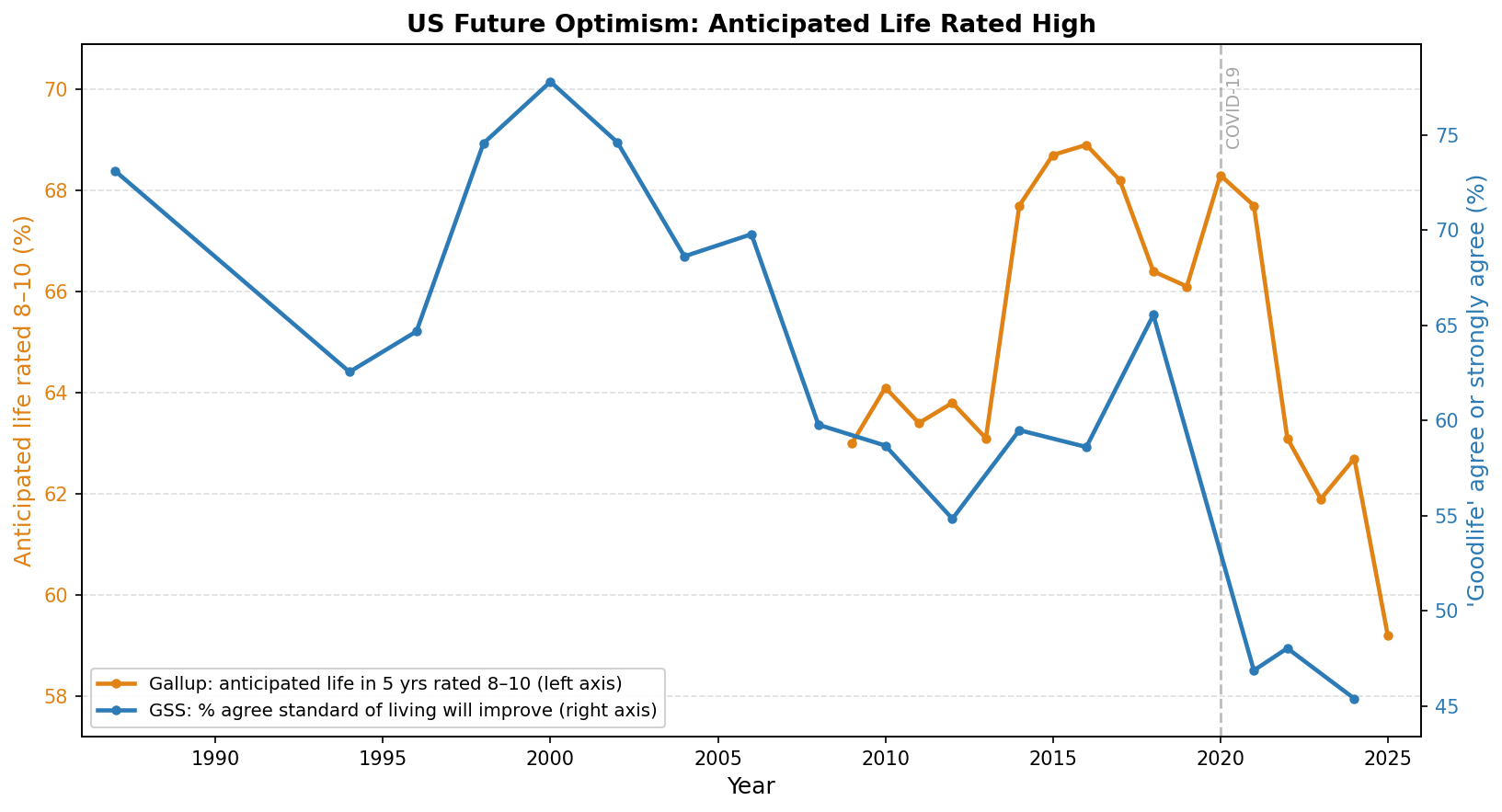
<p>There has also been a substantial change in how Americans perceive their future outlooks.</p>

<p><img src="/assets/images/us_goodlife_vs_gallup_future.png" alt="Share of Americans optimistic about the future: % agreeing their standard of living will improve (GSS goodlife, right axis) vs % rating anticipated life in 5 years at 8–10 (Gallup, left axis). Dual y-axis." /></p>

<p><em>Share of Americans optimistic about the future: GSS “goodlife” agree or strongly agree, and Gallup anticipated life in 5 years rated 8–10. Dual y-axis.</em></p>

<p>Note these trends do not track exactly the same thing. The GSS <code class="language-plaintext highlighter-rouge">goodlife</code> question asks “The way things are in America, people like me and my family have a good chance of improving our standard of living – do you agree or disagree?” This is a relative question about whether one will improve their situation. Gallup asks if people expect to rate their life an 8-10 in the next five years. So someone who thought their life would improve from a 6 to a 7 would agree with the GSS GoodLife question and disagree with the Gallup question, while someone who thought their life would stay steady at 9 would disagree with the GSS GoodLife question and agree with the Gallup question.</p>

<p>The GSS GoodLife question has been asked intermittently since 1987. It has bounced around since then but fallen substantially since the early 2000s. Gallup’s series covers a shorter window and documents a large drop in optimism about the future after 2020.</p>

<hr />

<h2 id="reproducing-this-analysis">Reproducing this analysis</h2>

<p>The full code is in the <a href="https://github.com/mattsclancy/us-happiness-wellbeing-trends">us-happiness-wellbeing-trends</a> repository.</p>

<h3 id="data">Data</h3>

<table>
  <thead>
    <tr>
      <th>File</th>
      <th>Source</th>
    </tr>
  </thead>
  <tbody>
    <tr>
      <td>GSS happiness cross-tab</td>
      <td><a href="https://gssdataexplorer.norc.org/">GSS Data Explorer</a>: variable <code class="language-plaintext highlighter-rouge">happy</code> × <code class="language-plaintext highlighter-rouge">year</code>, wtssps-weighted, exported as XLS</td>
    </tr>
    <tr>
      <td>GSS goodlife cross-tab</td>
      <td><a href="https://gssdataexplorer.norc.org/">GSS Data Explorer</a>: variable <code class="language-plaintext highlighter-rouge">goodlife</code> × <code class="language-plaintext highlighter-rouge">year</code>, wtssps-weighted, exported as XLS</td>
    </tr>
    <tr>
      <td>World Happiness Report</td>
      <td><a href="https://worldhappiness.report/">WHR 2026</a>, Figure 2.1 data download</td>
    </tr>
    <tr>
      <td>Gallup wellbeing index</td>
      <td>Gallup/Wellbeing Index, 2009–2025</td>
    </tr>
  </tbody>
</table>

<h3 id="dependencies">Dependencies</h3>

<div class="language-plaintext highlighter-rouge"><div class="highlight"><pre class="highlight"><code>pip install pandas openpyxl lxml matplotlib
</code></pre></div></div>

<p>Python 3.9+.</p>

<h3 id="generating-the-charts">Generating the charts</h3>

<div class="language-plaintext highlighter-rouge"><div class="highlight"><pre class="highlight"><code>python3 us_happiness_trends.py         # GSS score vs WHR life evaluation
python3 us_very_happy_vs_gallup.py     # % very happy vs % current life 7-10
python3 us_goodlife_vs_gallup_future.py  # % goodlife vs % future life 8-10
</code></pre></div></div>

<p>Run all scripts from the project root. Output is saved to <code class="language-plaintext highlighter-rouge">output/</code>.</p>

<hr />

<p><em>Related: <a href="https://mattsclancy.github.io/2026/04/12/happiness-is-reality-minus-expectations.html">Have our expectations outpaced economic growth?</a> uses fifty years of GSS data to test whether rising income expectations — rather than falling incomes — explain the happiness decline, finding that the income level at which Americans feel financially satisfied has grown faster than median income.</em></p>

<p><em>Related: <a href="https://mattsclancy.github.io/2026/04/21/gss-finrela-pessimism.html">Feeling Below Average at the Median</a> shows that the share of median-income Americans rating their family income as below average has roughly doubled since the 1970s.</em></p>

<p><em>Related: <a href="https://mattsclancy.github.io/2026/04/23/us-happiness-easterlin.html">The US Happiness Decline in International Context</a> puts the US within-country income–happiness relationship alongside 147 other countries, and tests whether the decline reflects mean reversion to a long-run cross-sectional trend.</em></p>

<p><em>Related: <a href="https://mattsclancy.github.io/2026/04/24/who-is-unhappy-in-america.html">Who Is Unhappy in America?</a> breaks the aggregate happiness decline down by age group (18–34, 35–54, 55+), showing that the post-2010 divergence has hit young Americans hardest.</em></p>

<p><em>Data: General Social Survey, NORC at the University of Chicago, 1972–2024 (wtssps weights applied throughout); World Happiness Report 2026, Figure 2.1; Gallup/Wellbeing Index, 2009–2025.</em></p>]]></content><author><name>Matt Clancy</name></author><category term="data" /><category term="wellbeing" /><category term="happiness" /><summary type="html"><![CDATA[American happiness is near all-time lows. This isn’t a new observation, but it is one worth documenting carefully, because the evidence is stronger than any single survey or question wording can convey.]]></summary></entry><entry><title type="html">Have our expectations outpaced economic growth?</title><link href="https://mattsclancy.github.io/2026/04/12/gss-financial-situation-thresholds.html" rel="alternate" type="text/html" title="Have our expectations outpaced economic growth?" /><published>2026-04-12T00:00:00+00:00</published><updated>2026-04-12T00:00:00+00:00</updated><id>https://mattsclancy.github.io/2026/04/12/gss-financial-situation-thresholds</id><content type="html" xml:base="https://mattsclancy.github.io/2026/04/12/gss-financial-situation-thresholds.html"><![CDATA[<p>Self-reported happiness and well-being has noticeably declined in the United States, and was <a href="https://mattsclancy.github.io/2026/04/19/us-happiness-wellbeing-trends.html">near all-time lows as of 2024-2025</a>. This is despite the fact that economic statistics are reasonably healthy - certainly not near all-time lows. Indeed, the country is by some measures richer than it has ever been (and much of that wealth is broadly shared).</p>

<p>So what’s going on?</p>

<p>One possible explanation is the old notion that “happiness is expectations minus reality.” If economic conditions have improved, but our expectations have outpaced the growth rate, that could lead to dissatisfaction with even very good economic outcomes.</p>

<p>To assess this, this post uses fifty years of data from the General Social Survey (GSS). The GSS has asked Americans about their happiness and financial satisfaction every year or two since 1972, making it an unusually long window into how people’s inner lives have tracked their material circumstances. It includes two questions that get at perceived financial wellbeing from different angles.</p>

<p><strong><code class="language-plaintext highlighter-rouge">finrela</code></strong> asks: <em>Compared with American families in general, would you say your family income is…?</em> The options run from “far below average” to “far above average.” This is a <em>relative</em> measure — it captures where you think you stand in the income distribution.</p>

<p><strong><code class="language-plaintext highlighter-rouge">satfin</code></strong> asks: <em>How satisfied are you with your present financial situation?</em> Respondents choose between “pretty well satisfied,” “more or less satisfied,” and “not satisfied at all.” This is an <em>absolute</em> measure — it reflects how you feel about your own situation, regardless of how others are doing.</p>

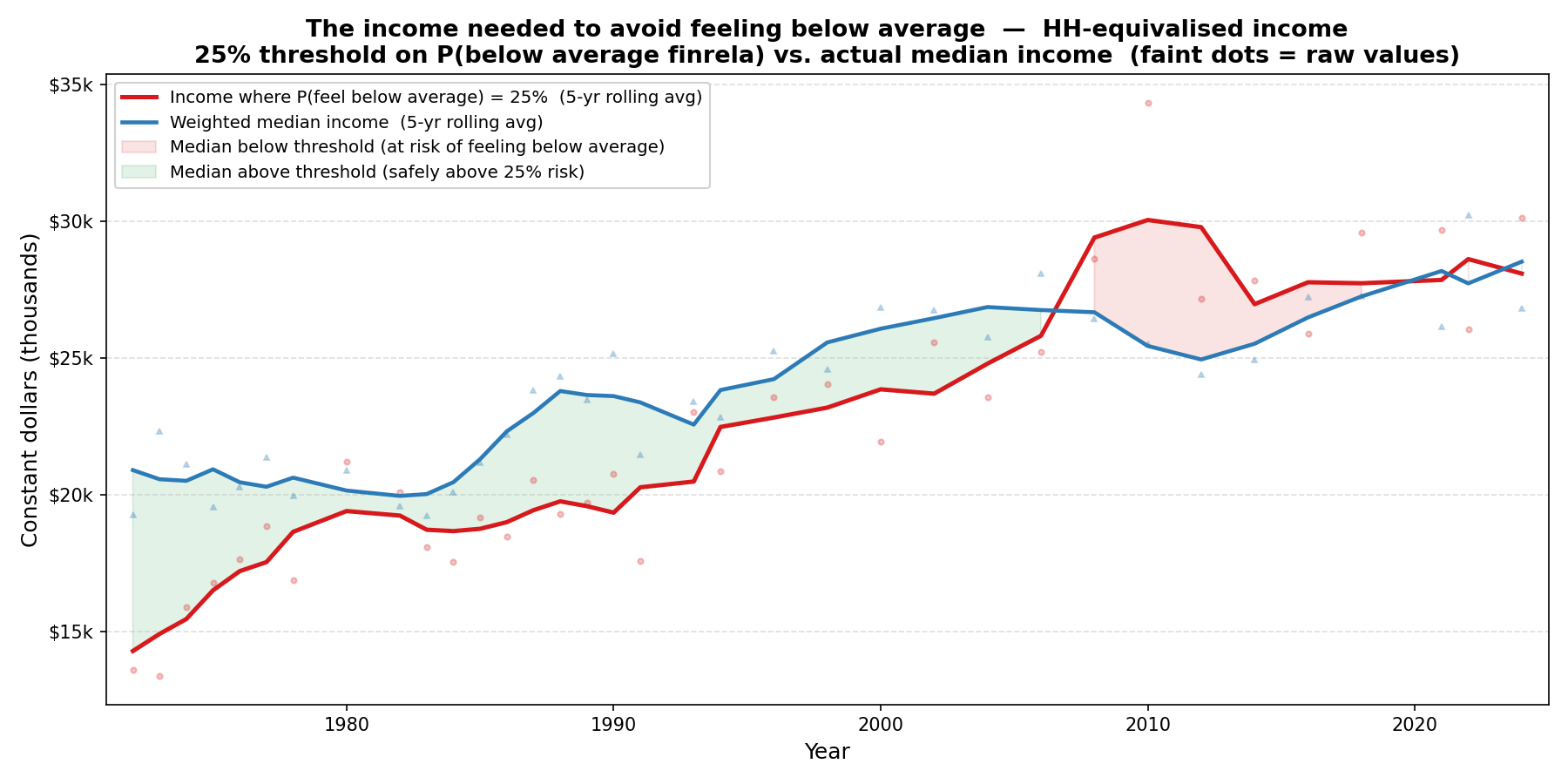
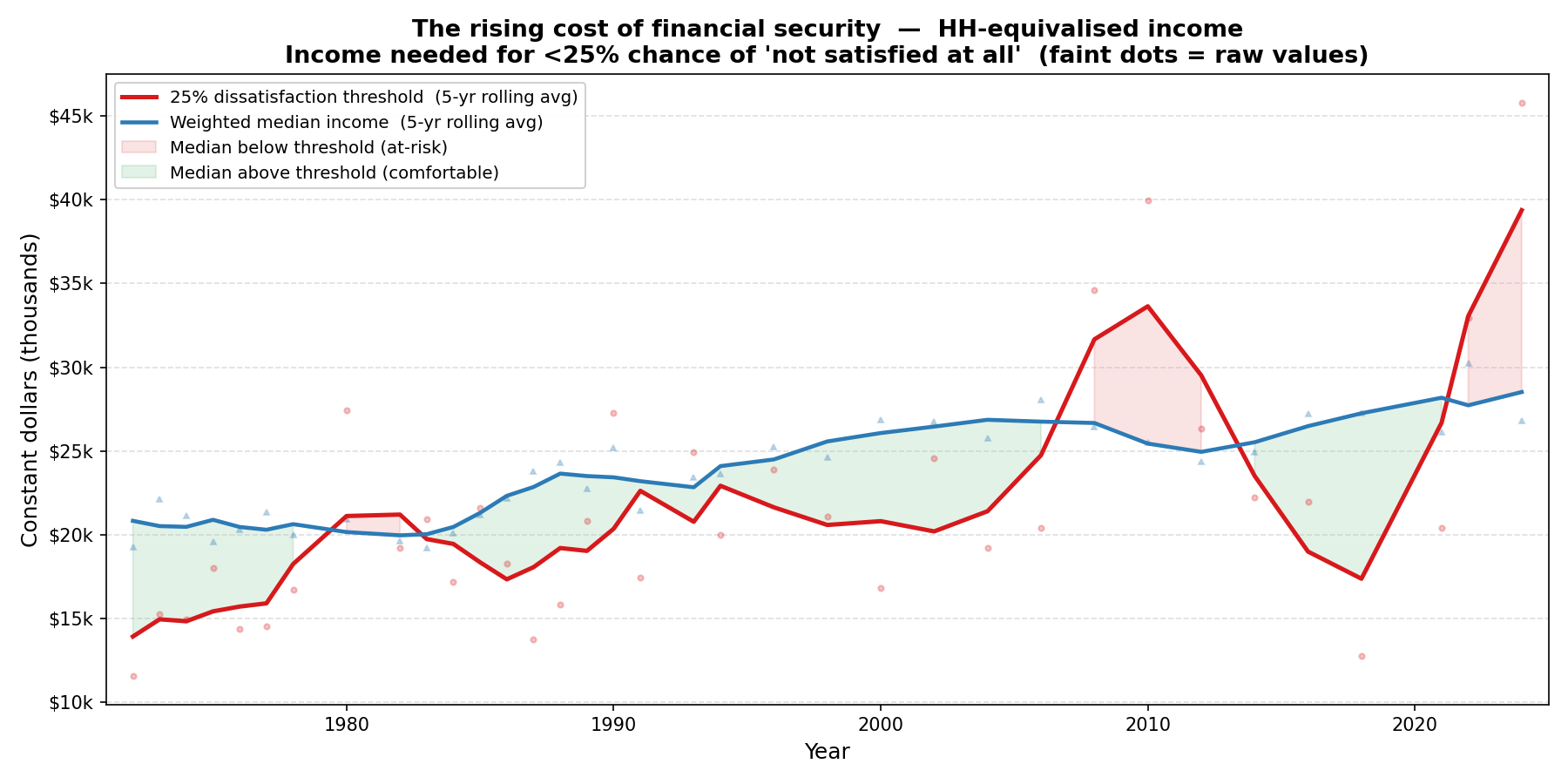
<p>The question I’m interested in is how people at different income levels perceive their financial situation, and how these perceptions have evolved over time. I will focus on people who report that they are in a bad financial situation: that their financial situation is below/far below average for American families in general, or that are not satisfied at all with their financial situation. Specifically, I am going to focus on the level of household income where people tell the GSS that they are in a bad financial situation at 25% of the time.</p>

<h2 id="the-methodology">The methodology</h2>

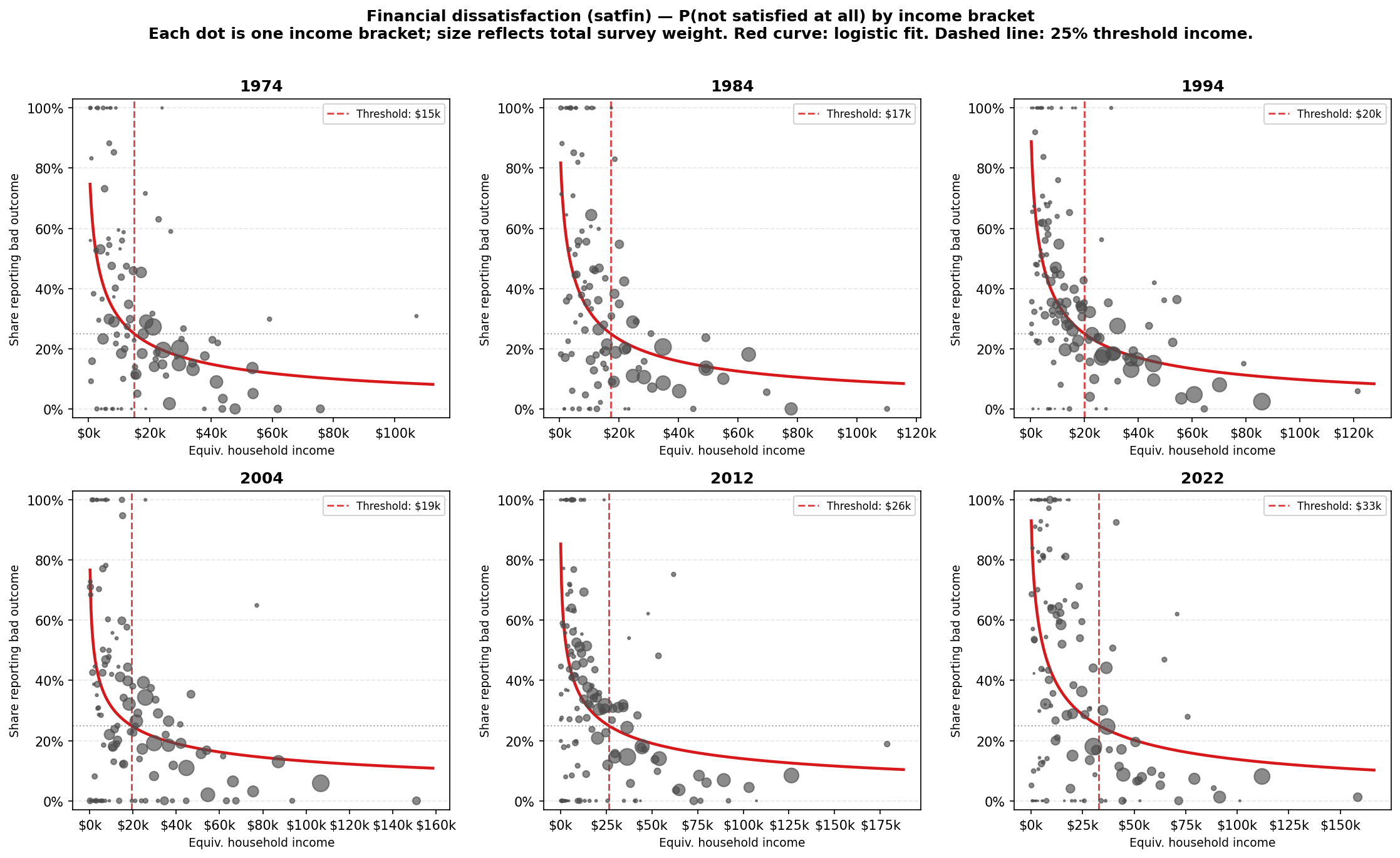
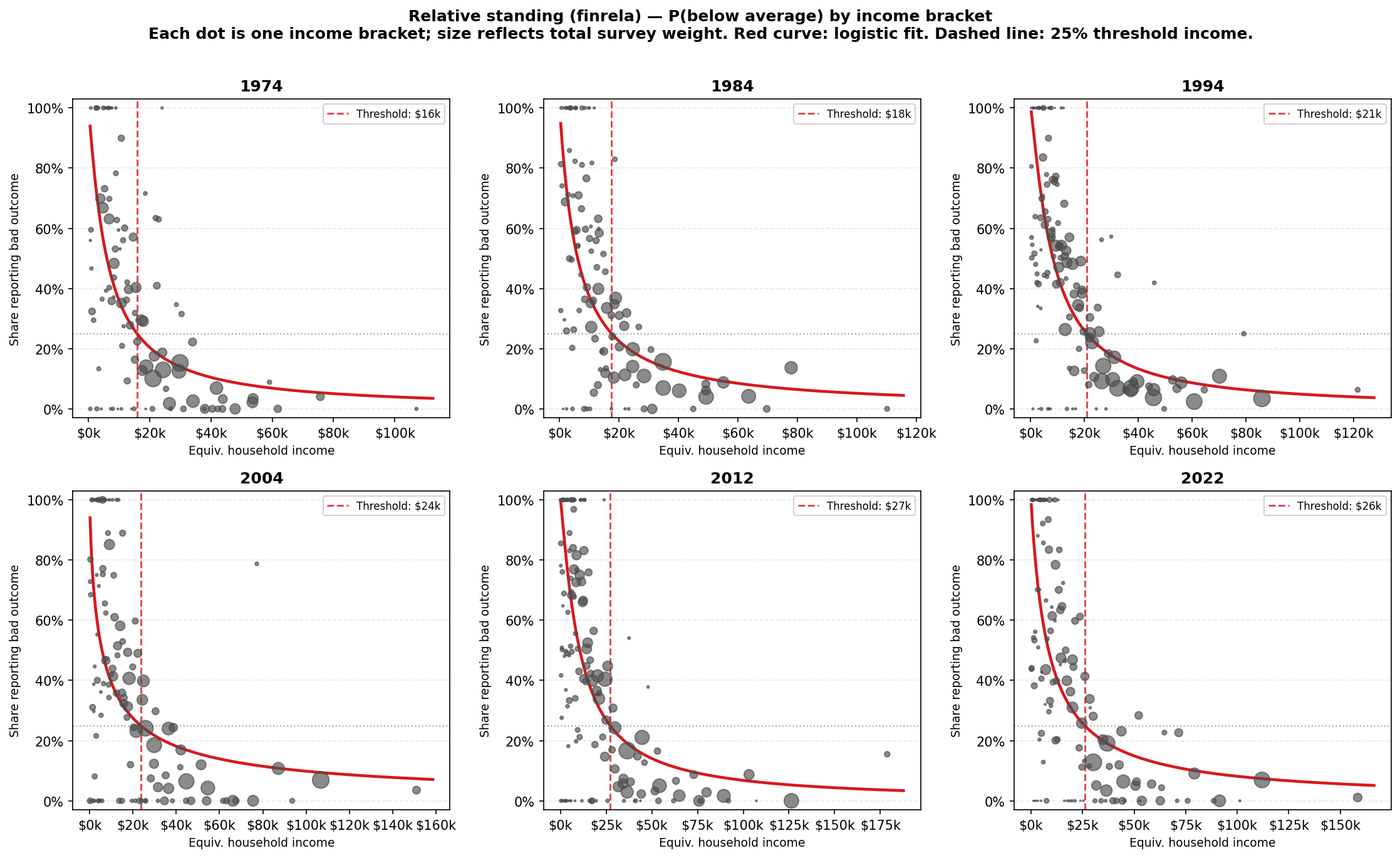
<p>To implement that, for each survey year, I fit a logistic regression of the probability of reporting a bad financial situation on the logarithm of household income adjusted for household size (so people who have the same household income but more people living in the household have a lower adjusted income). I use the OECD square-root equivalence scale - <a href="https://manhattan.institute/article/whether-and-how-to-adjust-income-trends-for-declining-household-size-part-2">read more here</a>. In general, the regressions show the more income a respondent reports, the less likely they are to report a bad financial outcome. I have a different logistic regression for every year in which there is a survey.</p>

<p>With the logistic regression, I can find the adjusted income level for a respondent where they report a bad financial situation exactly 25% of the time. This is the number I want to track over time. Specifically, this should be interpreted as a threshold - people who report an adjusted household income below this level are more than 25% likely to report a bad financial situation, and people who report an income above it are less than 25% likely to report a bad financial situation. It’s a noisy series, so income is smoothed with a ±2 calendar year centred window.</p>

<p>One important caveat: the GSS income variable is derived from categorical brackets, and the top bracket captures a growing share of respondents over time (roughly 3% in 1972, rising to 15% by 2024). This top-coding attenuates measured income growth and can distort the logistic regression slope. This is another reason I focus on bad financial situations, rather than good ones: we more precisely observe the incomes of people who are below the top category, and these are the people more likely to report bad financial situations.</p>

<h2 id="perceptions-that-your-income-is-below-average">Perceptions that your income is below average</h2>

<p>The first chart uses <code class="language-plaintext highlighter-rouge">finrela</code>. The threshold here is the income at which there is a 25% chance of describing one’s income as “below average” or “far below average.” In red, we see the imputed income level where one perceives oneself to be below or far below average with 25% probability. In blue, we have the actual median income of survey respondents.</p>

<p><img src="/assets/images/finrela_threshold_adjusted.png" alt="Income needed for less than a 25% chance of feeling &quot;below average&quot; on finrela, vs. actual median equivalised household income. Red shading indicates years in which the median household falls below imputed threshold income." /></p>

<p><em>Income needed for less than a 25% chance of feeling “below average” on finrela, vs. actual median equivalised household income. Red shading indicates years in which the median household falls below the imputed threshold income level.</em></p>

<p>Between the 1970s through the mid-2000s, the two lines rise roughly in parallel. Household incomes grow, and the income level at which people start to worry they are falling behind rises with it. But then, in the mid-2000s, around the onset of the global financial crisis, this relationship changes. From then on, the income level at which people start worrying they are falling behind actually rises <em>above</em> the income of the median respondent. People who are making average income start to report that they believe they are making below or far below average income.</p>

<h2 id="satisfaction-with-financial-situation">Satisfaction with financial situation</h2>

<p>The second chart uses <code class="language-plaintext highlighter-rouge">satfin</code>. For each year, the red line shows the equivalised household income at which there is a 25% chance of reporting “not satisfied at all” with one’s financial situation. The blue line shows the actual weighted median equivalised income of GSS respondents.</p>

<p><img src="/assets/images/satfin_threshold_adjusted.png" alt="Income needed for less than a 25% chance of financial dissatisfaction, vs. actual median equivalised household income. Red shading indicates years in which the median household falls below the imputed threshold." /></p>

<p><em>Income needed for less than a 25% chance of financial dissatisfaction, vs. actual median equivalised household income. Red shading indicates years in which the median household falls below the imputed threshold income.</em></p>

<p>Between the 1970s and mid-2000s, the two lines mostly rise together at a similar rate. One interpretation is that, as incomes rise, the level of income at which you become satisfied with your level of income also rises. In other words, there is a kind of hedonic treadmill effect, where greater prosperity leads to greater expectations. In the mid-2000s, this relationship breaks down though, and we start to see large swings in the imputed income level at which a respondent starts to report they are not at all satisfied with their financial situation. Following the global financial crisis, the level of income where people start to report dissatisfaction is well above the median income for survey respondents. This reverses for a period, but in the latest data we have, once again the income level at which people begin to report dissatisfaction with their income is way above the median reported income.</p>

<hr />

<h2 id="under-the-hood-the-logistic-regression">Under the hood: the logistic regression</h2>

<p>For each survey year, the threshold is estimated by fitting a logistic regression
  to the raw survey responses and reading off where the fitted curve crosses 25%.                                     <br />
  The charts below show what that looks like for six anchor years.</p>

<p>Each dot is one income bracket — its horizontal position is the bracket midpoint                                    <br />
  (adjusted for household size), its vertical position is the weighted share of                                       <br />
  respondents in that bracket who reported the bad outcome, and its size is                                           <br />
  proportional to the total survey weight in that bracket. The red curve is the                                       <br />
  fitted logistic regression; the dashed line marks the 25% threshold income.</p>

<p><strong>Financial dissatisfaction (<code class="language-plaintext highlighter-rouge">satfin</code>)</strong></p>

<p><img src="/assets/images/satfin_curves.png" alt="Logistic regression curves for satfin across six anchor years, showing the                                          
  share of respondents reporting &quot;not satisfied at all&quot; by income bracket, with                                         
  the fitted logistic curve and 25% threshold marked." /></p>

<p><strong>Relative standing (<code class="language-plaintext highlighter-rouge">finrela</code>)</strong></p>

<p><img src="/assets/images/finrela_curves.png" alt="Logistic regression curves for finrela across six anchor years, showing the                                         
  share of respondents reporting &quot;below average&quot; by income bracket, with the   
  fitted logistic curve and 25% threshold marked." /></p>

<hr />

<h2 id="reproducing-this-analysis">Reproducing this analysis</h2>

<p>The full code is in the <a href="https://github.com/mattsclancy/gss-financial-situation-thresholds">gss-financial-situation-thresholds</a> repository.</p>

<h3 id="data">Data</h3>

<p>The GSS data is not included in the repository. Download your own extract from <a href="https://gssdataexplorer.norc.org/">GSS Data Explorer</a> with these variables:</p>

<table>
  <thead>
    <tr>
      <th>Variable</th>
      <th>Description</th>
    </tr>
  </thead>
  <tbody>
    <tr>
      <td><code class="language-plaintext highlighter-rouge">satfin</code></td>
      <td>Satisfaction with financial situation (3 categories)</td>
    </tr>
    <tr>
      <td><code class="language-plaintext highlighter-rouge">happy</code></td>
      <td>General happiness (3 categories)</td>
    </tr>
    <tr>
      <td><code class="language-plaintext highlighter-rouge">finrela</code></td>
      <td>Opinion of family income relative to others (5 categories)</td>
    </tr>
    <tr>
      <td><code class="language-plaintext highlighter-rouge">coninc</code></td>
      <td>Family income in constant dollars (top-coded bracket midpoints)</td>
    </tr>
    <tr>
      <td><code class="language-plaintext highlighter-rouge">hompop</code></td>
      <td>Number of people in household</td>
    </tr>
    <tr>
      <td><code class="language-plaintext highlighter-rouge">wtssps</code></td>
      <td>Post-stratification survey weight</td>
    </tr>
  </tbody>
</table>

<p>Save the file as <code class="language-plaintext highlighter-rouge">data/GSS.xlsx</code> in the project root. Note that <code class="language-plaintext highlighter-rouge">wtssps</code> must be added explicitly — it is not included in GSS extracts by default.</p>

<h3 id="dependencies">Dependencies</h3>

<div class="language-plaintext highlighter-rouge"><div class="highlight"><pre class="highlight"><code>pip install pandas openpyxl scikit-learn matplotlib statsmodels
</code></pre></div></div>

<p>Python 3.9+.</p>

<h3 id="generating-the-charts">Generating the charts</h3>

<p>The two charts in this post are produced by:</p>

<div class="language-plaintext highlighter-rouge"><div class="highlight"><pre class="highlight"><code>python3 gss_threshold.py       # financial dissatisfaction threshold (satfin)
python3 gss_finrela_worst.py   # relative standing threshold (finrela)
</code></pre></div></div>

<p>Output is saved to <code class="language-plaintext highlighter-rouge">output/threshold/threshold_adjusted.png</code> and <code class="language-plaintext highlighter-rouge">output/finrela_worst/threshold_adjusted.png</code> respectively. Run all scripts from the project root.</p>

<hr />

<p><em>Related: <a href="https://mattsclancy.github.io/2026/04/21/gss-finrela-pessimism.html">Feeling Below Average at the Median</a> takes a complementary approach — instead of modelling a threshold, it directly measures the share of median-income respondents who report feeling below average, and finds the same post-2008 deterioration.</em></p>

<p><em>Related: <a href="https://mattsclancy.github.io/2026/04/19/us-happiness-wellbeing-trends.html">US happiness has fallen to record lows</a> documents the broader decline in American wellbeing across the GSS happiness question, the World Happiness Report Cantril ladder, and Gallup’s wellbeing index.</em></p>

<p><em>Related: <a href="https://mattsclancy.github.io/2026/04/24/who-is-unhappy-in-america.html">Who Is Unhappy in America?</a> breaks the <code class="language-plaintext highlighter-rouge">finrela</code> and <code class="language-plaintext highlighter-rouge">satfin</code> trends down by age group, showing that young Americans have driven the long-run deterioration in perceived relative financial position.</em></p>

<p><em>Data: General Social Survey, NORC at the University of Chicago, 1972–2024. Income adjusted to constant dollars and equivalised for household size (OECD square-root scale). Survey weights (wtssps) applied throughout.</em></p>]]></content><author><name>Matt Clancy</name></author><category term="data" /><category term="economics" /><category term="wellbeing" /><summary type="html"><![CDATA[Self-reported happiness and well-being has noticeably declined in the United States, and was near all-time lows as of 2024-2025. This is despite the fact that economic statistics are reasonably healthy - certainly not near all-time lows. Indeed, the country is by some measures richer than it has ever been (and much of that wealth is broadly shared).]]></summary></entry></feed>